Sensing AI Incidents & Risks from Global News
Introduction
The development and deployment of Artificial Intelligence (AI) technologies has become a globally-experienced phenomenon, although perceptions and regulatory frameworks vary widely across jurisdictions. As AI systems are increasingly deployed in urban environments—from traffic management and public safety to healthcare and education—there is a critical need for systematic monitoring and assessment of AI-related risks and incidents reported in global news media.
This brief presents an Large Lanugage Model (LLM)-based Urban AI Risks (UAIR) assessment pipeline, a comprehensive system for extracting, verifying, and classifying risk information about AI use cases from large-scale news article collections. The pipeline processes raw HTML articles through a five-stage workflow that combines large language model (LLM) inference, semantic verification, and regulatory classification to produce structured datasets suitable for policy analysis and risk assessment.
Core Technologies
The UAIR pipeline leverages three foundational technologies that enable its scalable, configuration-driven architecture:
Hydra: Hydra is a framework for elegantly configuring complex
applications, developed by Facebook Research. It provides hierarchical
configuration management through YAML files and Python dataclasses,
enabling composition, inheritance, and runtime overrides without code
changes. Hydra’s key features include config groups (modular, reusable
configuration components), variable interpolation (supporting
environment variables, config references, and computed values), and
command-line overrides (allowing any configuration parameter to be
modified at runtime). In UAIR, Hydra orchestrates the entire pipeline by
managing stage configurations, model parameters, prompt templates, and
SLURM launcher settings. Pipeline definitions are specified as YAML
files that compose base configurations with stage-specific overrides,
enabling experimentation and production deployments from the same
codebase. The CLI entry point uses Hydra’s @hydra.main decorator to
load configurations, resolve dependencies, and execute the pipeline DAG.
Ray Data: Ray is an AI compute engine consisting of a core distributed runtime and specialized libraries for accelerating ML workloads. Ray Data provides scalable, framework-agnostic data loading and transformation for ML workloads, facilitating distributed data processing across training, tuning, and prediction tasks. Key capabilities include lazy evaluation (operations are not executed until results are materialized), automatic parallelization (distributing operations across available CPUs), streaming I/O (processing datasets larger than available RAM), and fault tolerance (configurable error handling and retry logic). In UAIR, Ray Data enables memory-efficient processing of large article collections by automatically parallelizing operations like text extraction, batch inference, and result aggregation. The system uses Ray Datasets for distributed processing, with automatic conversion to pandas DataFrames for smaller datasets or when streaming is disabled. Ray initialization is SLURM-aware, automatically detecting CPU allocations and configuring the runtime accordingly.
vLLM: vLLM is a high-throughput and memory-efficient inference engine for large language models, designed to accelerate LLM serving with features like PagedAttention (efficient memory management for KV caches), continuous batching (dynamically batching requests as they arrive), and various quantization methods. vLLM achieves 2–4x higher throughput than traditional batching approaches while maintaining low latency. Key optimizations include prefix caching (reusing KV cache for repeated prompt prefixes), chunked prefill (reducing memory fragmentation for long contexts), and tensor parallelism (distributing model layers across multiple GPUs). In UAIR, vLLM powers all LLM inference stages (classification, decomposition, EU Act classification, risks/benefits assessment) through Ray Data’s LLM processor integration. The system configures vLLM engines with stage-specific parameters (context length, batch size, memory utilization) and uses guided decoding for structured outputs, ensuring schema compliance without post-processing. vLLM’s continuous batching keeps GPU utilization high even with variable-length inputs, critical for processing heterogeneous article collections.
Qwen3-30B-A3B: Qwen3-30B-A3B is a 30-billion parameter Mixture-of-Experts (MoE) language model developed by Alibaba Group, part of the Qwen3 series of advanced large language models. The model employs a sparse MoE architecture that activates approximately 3 billion parameters per inference (A3B denotes “3B active”) out of 30.5 billion total parameters, enabling capabilities comparable to larger dense models while maintaining computational efficiency. Key capabilities include advanced reasoning and instruction following, multilingual understanding across 119 languages and dialects, extended context handling (up to 128,000 tokens, though UAIR configures 16,384–20,480 tokens per stage), and strong performance on complex tasks requiring structured output generation. The model supports both “thinking” and “non-thinking” modes, with the thinking mode enabling explicit reasoning processes for complex problem-solving. In UAIR, Qwen3-30B-A3B-Instruct serves as the primary LLM for all inference stages, configured via vLLM with GPU memory utilization of 0.9, chunked prefill enabled for long contexts, prefix caching for repeated prompts, and tensor parallelism matching available GPUs (typically 2–4 GPUs). The model’s combination of reasoning capabilities, multilingual support, and efficient MoE architecture makes it well-suited for extracting structured information from diverse news sources and performing regulatory classification tasks across different languages and domains.
Weights & Biases: Weights & Biases (W&B) is a comprehensive platform for tracking and visualizing machine learning experiments, datasets, and models, designed to help teams build better models faster through systematic experiment management. W&B provides experiment tracking capabilities including metrics logging (loss, accuracy, custom metrics), hyperparameter tracking, system monitoring (CPU/GPU utilization, memory usage, network activity), artifact management (dataset and model versioning), and collaborative features (run comparison, visualization dashboards, team workspaces). The platform supports both online mode (real-time syncing to cloud) and offline mode (deferred syncing for environments with limited network access). Key features include run grouping (organizing related experiments), run comparison (comparing metrics across runs), custom visualizations (plotting metrics over time), and artifact versioning (tracking datasets and models across experiments). In UAIR, W&B integration provides centralized experiment tracking across all pipeline stages, with each stage creating a separate run grouped under the same pipeline execution. The system logs token usage (prompt, output, total), latency metrics (per-article and batch-level), stage-specific statistics (relevance rates, verification success rates), and compute metadata (CPU count, GPU count, model paths). Tables are logged with configurable sampling to enable result inspection without overwhelming the interface. The integration uses in-process mode (service daemon disabled) for compatibility with SLURM and Ray distributed environments, ensuring reliable logging in cluster computing scenarios.
System Architecture
The UAIR pipeline integrates these technologies into a configuration-driven architecture designed to scale from small test runs (hundreds of articles) to production-scale processing of millions of articles across SLURM-managed GPU clusters.
The pipeline operates as a directed acyclic graph (DAG) where each stage is independently configurable and can be executed in parallel when dependencies permit. Hydra manages the DAG structure, resolving dependencies through topological sorting and coordinating stage execution via SLURM job submission or local execution. Ray Data handles distributed data processing, automatically parallelizing operations and managing memory through lazy evaluation and streaming I/O. vLLM provides efficient batched LLM inference, with engines configured per-stage to optimize throughput and memory usage.
All intermediate results are persisted as Parquet files, enabling partial pipeline execution, result inspection, and incremental processing. The system integrates with Weights & Biases for experiment tracking, providing real-time monitoring of token usage, latency, and output statistics across all stages.
Key Capabilities
The pipeline addresses several critical challenges in large-scale AI risk monitoring:
Relevance Filtering: Efficiently identifies AI-relevant articles from heterogeneous news sources using LLM-based classification with optional keyword pre-filtering to reduce computational costs. The binary classification (YES/NO) uses guided decoding to ensure deterministic outputs.
Structured Extraction: Decomposes articles into standardized tuples capturing deployment context, actors, locations, and impacts using guided decoding to ensure schema compliance. The 13-field schema includes deployment characteristics (domain, purpose, capability, space), actor identities (deployer, subject, developer), geographic and temporal information, and impact lists (harms, risks, benefits). Missing information is explicitly tracked rather than filled with placeholders.
Claim Verification: Validates extracted tuples against source text using a combination of semantic similarity (embedding-based) and natural language inference (NLI) models to ensure factual accuracy. The “combo” verification method combines cosine similarity scores, entailment probabilities, and contradiction detection with configurable thresholds.
Regulatory Classification: Maps AI deployments to EU AI Act risk categories (Prohibited, High Risk, Limited/Low Risk) with explicit citations to regulatory text and amendments. The classification process follows a four-step methodology ensuring strict reasoning verification and amendment awareness, with vague articles explicitly flagged to prevent misclassification.
Impact Assessment: Extracts detailed risk and benefit analyses including human rights impacts (aligned with UDHR) and Sustainable Development Goal (SDG) assessments. The structured output includes nested assessments for all 30 UDHR articles, SDG targets, and PESTLE categories, providing comprehensive impact analysis suitable for policy evaluation.
Data
Dataset Overview
The UAIR dataset combines news articles from the United States and a global subset, totaling over 415,000 articles across 49 countries. Figure 1 visualizes the geographic distribution of articles, with countries colored by article count using a yellow-orange-red colormap. Countries with no articles are shown in gray.
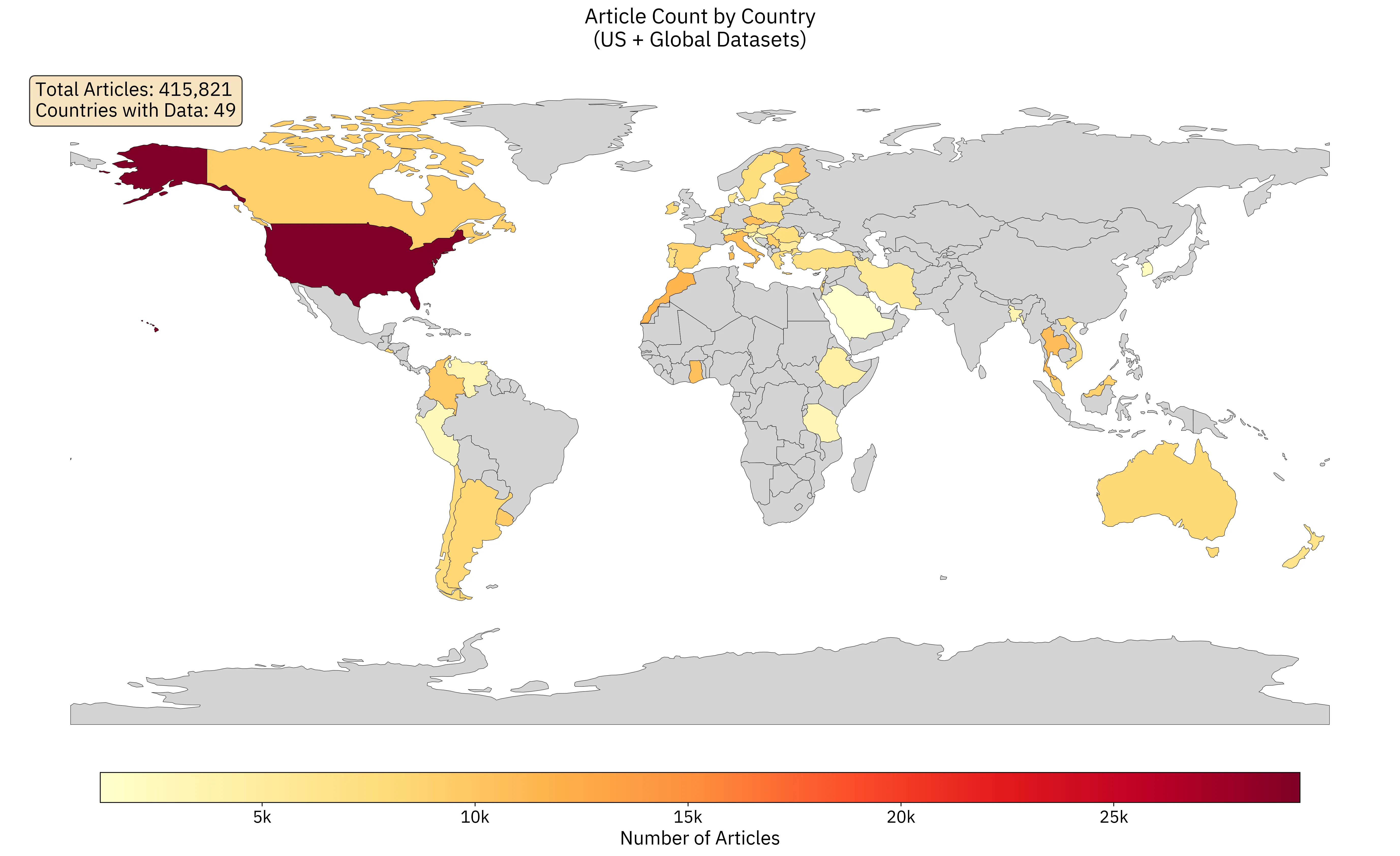
Table [tab:country_article_counts_all] presents the top 20 countries by article count. The United States dominates the dataset with 29,372 articles (7.1% of total), followed by Morocco (11,617 articles), Thailand (10,867 articles), and Italy (10,583 articles). The dataset exhibits significant geographic diversity, with representation across all major continents, though coverage is concentrated in North America, Europe, and select regions in Africa, Asia, and South America.
| Top 25 Countries | Bottom 24 Countries | ||||
|---|---|---|---|---|---|
| 1-3 (lr)4-6 Country | ISO | Count | Country | ISO | Count |
| United States of America | US | 29,372 | Luxembourg | LU | 7,488 |
| Morocco | MA | 11,617 | Romania | RO | 7,390 |
| Thailand | TH | 10,867 | Poland | PL | 7,315 |
| Italy | IT | 10,583 | Vietnam | VN | 7,290 |
| Czechia | CZ | 10,563 | Turkey | TR | 7,038 |
| Ghana | GH | 10,518 | Latvia | LV | 7,018 |
| Finland | FI | 10,241 | Portugal | PT | 6,915 |
| Colombia | CO | 9,808 | New Zealand | NZ | 6,626 |
| Uruguay | UY | 9,632 | Austria | AT | 6,307 |
| Serbia | RS | 9,210 | Estonia | EE | 6,068 |
| Canada | CA | 9,180 | Denmark | DK | 5,878 |
| Netherlands | NL | 9,007 | Hungary | HU | 5,538 |
| Malaysia | MY | 8,986 | Iran | IR | 5,483 |
| Spain | ES | 8,713 | Bulgaria | BG | 5,079 |
| Trinidad and Tobago | TT | 8,509 | Slovenia | SI | 4,614 |
| Argentina | AR | 8,457 | Ethiopia | ET | 4,470 |
| El Salvador | SV | 8,317 | Venezuela | VE | 3,406 |
| Ireland | IE | 8,252 | Bangladesh | BD | 3,307 |
| Australia | AU | 8,231 | Switzerland | CH | 3,188 |
| Belgium | BE | 8,060 | Tanzania | TZ | 3,054 |
| Chile | CL | 7,783 | Peru | PE | 2,686 |
| Israel | IL | 7,782 | Croatia | HR | 2,437 |
| Sweden | SE | 7,589 | South Korea | KR | 2,112 |
| Lithuania | LT | 7,576 | Saudi Arabia | SA | 1,197 |
| Greece | GR | 7,570 | |||
Data Collection and Preprocessing
The UAIR pipeline processes news articles collected from diverse sources and stored as HTML files. The preprocessing pipeline converts raw HTML into clean text suitable for LLM processing through a multi-stage workflow.
Article Aggregation
Articles are initially collected as individual text files organized by
year and country. The aggregation script (us_agg.py) scans directory
structures using glob patterns to discover all article files, extracts
metadata (country, year from directory structure), and loads article
text content. The script uses pandas with progress bars (tqdm) for
efficient parallel processing, storing results in Parquet format with
optimized row group sizes (500 rows per group) to balance file size and
parallel processing efficiency.
The aggregation produces two outputs: (1) all_articles_meta.parquet
containing metadata (article_path, country, year) without text content,
and (2) all_articles.parquet containing full article text. Row group
sizing is optimized for Ray Data processing, targeting approximately
250–500MB compressed per group to enable efficient parallelization.
HTML to Text Extraction
Raw HTML articles are converted to clean text using the Trafilatura
library (extract_text_trafilatura.py), a specialized tool designed for
extracting main content from web pages while filtering out navigation,
advertisements, and other boilerplate. The extraction process uses the
following configuration:
-
include_comments: false— Excludes HTML comments -
include_tables: false— Excludes table content (can slow processing) -
include_images: false— Excludes image alt text -
include_links: false— Excludes link text -
include_formatting: false— Excludes formatting information -
deduplicate: true— Removes duplicate text blocks -
output_format: "txt"— Plain text output
The extraction function handles edge cases including empty or invalid
HTML, extraction failures (Trafilatura returns None on failure), and
very short content. Failed extractions are logged with warnings, and the
original HTML length is preserved for comparison statistics. The script
processes articles in batch with progress tracking, replacing the
article_text column with extracted text to avoid storing both HTML and
text (reducing file size by approximately 60–80%).
Data Format and Schema
All pipeline stages operate on Parquet-formatted datasets with standardized schemas. The base article schema includes:
-
article_id— Unique identifier (SHA-1 hash of article path or text if path unavailable) -
article_text— Clean extracted text content -
article_path— Source file path -
country— Country code (e.g., “us”) -
year— Publication year extracted from directory structure
Downstream stages extend this schema with stage-specific fields. For
example, the classification stage adds is_relevant (boolean),
relevance_score (float), and classification_mode (string). The
decomposition stage adds 13 tuple fields, and verification stages add
similarity scores and verification flags.
Data Processing Modes
The pipeline supports two data processing modes optimized for different scales:
Pandas Mode: For small to medium datasets (up to approximately 100k articles), data is loaded entirely into memory as pandas DataFrames. This mode provides fast iteration and debugging but is memory-limited.
Ray Data Mode: For large-scale processing, data flows through Ray Datasets with lazy evaluation and distributed processing. Ray Data automatically parallelizes operations across available CPUs, supports streaming I/O for memory efficiency, and can process datasets larger than available RAM. The system detects dataset size and automatically selects the appropriate mode, with manual override available via configuration.
Data Flow and Artifact Management
The orchestrator maintains an internal artifact registry that maps
logical names to file paths, enabling stages to reference outputs from
previous stages using dot notation (e.g., classify.relevant resolves
to the path of relevant articles from the classification stage). This
abstraction allows pipeline reconfiguration without modifying stage
code.
Registry Resolution: The registry resolves references in three
stages: (1) sources are registered at pipeline start from
pipeline.sources configuration, (2) stage outputs are registered after
successful stage execution using output specifications, and (3)
downstream stages resolve inputs by looking up registered names.
Multi-output stages (e.g., classify.all and classify.relevant)
enable selective consumption of outputs by downstream stages.
Output Persistence: All intermediate outputs are persisted as
Parquet files with descriptive paths following the pattern
outputs/STAGE_NAME/FILENAME.parquet. Paths are resolved relative to
pipeline.output_root, which defaults to
${hydra:run.dir}/PIPELINE_NAME. This organization enables easy
navigation of pipeline outputs and supports result inspection without
re-execution.
Partial Execution: The system supports partial pipeline execution
through the allow_partial configuration flag. When enabled, stages can
be skipped if their outputs already exist (checked via file existence).
This enables incremental processing, result inspection, and debugging
without full re-execution. The manifest file (manifest.json) tracks
execution status and metadata for each stage.
Schema Evolution: Parquet’s schema evolution capabilities enable adding columns in downstream stages without breaking compatibility. However, the pipeline maintains explicit schemas per stage to ensure data quality. Schema validation occurs at stage boundaries, with errors logged to W&B for monitoring.
Methods
Our pipeline processes large-scale news articles through a five-stage workflow designed to extract, verify, and classify urban AI risk information. The system is implemented as a configuration-driven pipeline using Hydra for orchestration, Ray Data for distributed processing, and vLLM for efficient large language model inference.
Pipeline Architecture
The full event pipeline processes articles through the following stages: (1) relevance classification, (2) tuple decomposition, (3) tuple verification, (4) EU AI Act classification, and (5) risks and benefits classification. Each stage operates on Parquet-formatted datasets and can be executed independently or as part of the complete workflow.
Stage 1: Relevance Classification
The first stage filters articles for relevance to AI risks using large language model (LLM) classification. Articles are processed in batches through a vLLM inference engine, with each article classified as relevant or not relevant based on its content. The stage supports optional keyword-based pre-filtering to reduce computational costs by gating articles before LLM processing.
Prompt Design: The classification uses a binary relevance prompt with a system message identifying the model as a “careful news analyst trained to decide if a news article is related to artificial intelligence (AI) in any substantive way.” The user template presents article text (optionally chunked for long articles) and requests a strict YES/NO response. The prompt includes article metadata (article_id, chunk identifiers) to aid in tracking and debugging.
Keyword Pre-filtering: To reduce LLM processing costs, the stage
supports keyword-based buffering with configurable modes: pre_gating
(filter before LLM), post_gating (compute flag only), or off (no
filtering). The keyword regex matches AI-related terms including
“artificial intelligence,” “machine learning,” “neural network,” “large
language model,” and common model names (GPT, Claude, Gemini, etc.).
Guided Decoding: Classification uses guided decoding with a choice constraint limiting outputs to “YES” or “NO,” ensuring deterministic binary classification without post-processing. This eliminates parsing errors and ensures consistent output format.
Configuration Parameters: Batch size is typically 16 articles per batch, GPU memory utilization 0.8, and maximum model context length 8,192 tokens. The stage outputs two datasets: all articles with relevance scores, and a filtered set containing only relevant articles. On the US dataset, this filtered set contains 578 articles (1.97% of 29,372 input articles) for downstream processing.
Stage 2: Tuple Decomposition
Relevant articles are decomposed into structured tuples using LLM-based information extraction. The decomposition extracts 13 core fields: deployment domain, deployment purpose, deployment capability, identity of AI deployer, identity of AI subject, identity of AI developer, location of AI deployer, location of AI subject, date and time of event, deployment space (publicly accessible or not), list of harms that occurred, list of risks that occurred, and list of benefits that occurred.
Prompt Design: The decomposition prompt instructs the model to act as an “expert artificial intelligence safety researcher trained in extracting and summarizing urban AI risks from news articles.” The prompt emphasizes focusing on the original intended AI use (even if misused) and requires action verbs describing how the technology is used. Each field must be output in less than 7 words, with specificity at a general level rather than concrete instances. Fields not specified in the article are explicitly listed under “missing” rather than filled with placeholders.
Schema Enforcement: The extraction uses guided decoding with a JSON
schema generated from a Pydantic model. The schema defines field types
(strings, enums, arrays) and required fields. Schema references ($ref)
are inlined for xgrammar compatibility. The guided decoding
configuration enforces strict schema compliance
(disable_fallback: true, disable_additional_properties: true),
ensuring outputs conform to the expected structure without
post-processing.
Model Configuration: The LLM is configured with a larger context window (20,480 tokens) to accommodate full article text, with batch size reduced to 4 articles per batch to manage memory constraints. GPU memory utilization is set to 0.9 to maximize throughput while maintaining stability. The stage uses temperature 0 for deterministic extraction.
Stage 3: Tuple Verification
Extracted tuples are verified against the source article text using a combination of semantic similarity and natural language inference (NLI). The verification stage uses two models: an embedding model (intfloat/e5-base) for semantic similarity matching and an NLI model (mdeberta-v3-base-xnli-multilingual) for contradiction detection.
The verification method employs a “combo” approach that combines
similarity scores, entailment probabilities, and contradiction
detection. Thresholds are set at similarity $\geq 0.55$, entailment
$\geq 0.85$, and contradiction $\leq 0.05$. The system identifies
the top-k most relevant text spans (typically $k=5$) from the article
for each tuple field and verifies claims against these spans. A core
tuple is considered verified if its key fields (domain, purpose,
capability, deployer, subject) meet the verification thresholds. On the
US dataset, 61 of 578 decomposed articles (10.5%) pass core tuple
verification.
Stage 4: EU AI Act Classification
Verified tuples are classified according to the EU AI Act risk categories: Prohibited, High Risk, or Limited/Low Risk. The classification stage uses LLM inference with a specialized prompt that includes relevant portions of the EU AI Act and its amendments.
Prompt Design: The system prompt identifies the model as an “experienced regulatory compliance specialist who works in the field of artificial intelligence (AI) technology regulation” with access to the full EU AI Act and amendments. The user template implements a four-step classification process: (1) writing a brief description starting with “The usage of AI is…” in language similar to the Act, (2) determining Prohibited or High Risk status with exact text citations and strict reasoning verification, (3) checking amendments for classification changes with explicit amendment references, and (4) classifying as Limited/Low Risk if neither Prohibited nor High Risk. The prompt emphasizes attention to subject and user identity, purpose, and capability, as these are critical for risk classification.
Vague Article Filtering: Before LLM processing, articles are checked
for vagueness using keyword-based heuristics. Articles flagged as “too
vague to process” are excluded from classification and marked with
too_vague_to_process = True. This prevents misclassification of
articles lacking sufficient detail for regulatory assessment. On the US
dataset, 17 of 61 verified articles (27.9%) are flagged as too vague to
process.
Guided Decoding Schema: The classification uses guided decoding with
a JSON schema defining the expected output structure: eu_ai_label
(enum: Prohibited, High Risk, Limited or Low Risk), eu_ai_desc
(string), eu_ai_relevant_text (string with Act citations),
eu_ai_reason (string with detailed reasoning), and optional amendment
references.
Input Gating: The classification is gated to only process tuples
where core_tuple_verified = True, ensuring that classifications are
based on reliable extractions. Deduplication by article_id ensures one
classification per article. The stage uses a context window of 16,384
tokens and temperature 0 for deterministic outputs.
Stage 5: Risks and Benefits Classification
The final stage extracts detailed risk and benefit assessments, including impacts on human rights and Sustainable Development Goals (SDGs). The classification produces structured JSON output containing: a description of the risks and benefits, an assessment of impact on human rights (aligned with the Universal Declaration of Human Rights), an assessment of impact on SDGs, and additional impacts (PESTLE analysis).
Prompt Design: The system prompt identifies the model as a “renowned specialist in the field of AI technology with a dedicated focus on understanding, promoting, and supporting Universal Human Rights,” with comprehensive knowledge of all 30 articles from the UN Universal Declaration of Human Rights. The user template implements a six-step assessment process: (1) describing the AI system in language parallel to UDHR/SDG phrasing, (2) evaluating each human right with Positive/Negative/Mixed classification, (3) assessing SDG impacts, (4) identifying additional risks, (5) providing overall risk-benefit summary, and (6) generating structured output.
Complex Schema: The guided decoding schema includes nested structures for human rights assessments (array of objects with right name, impact classification, and reasoning), SDG assessments (array of objects with goal number, target, impact, and reasoning), and additional impacts (PESTLE categories: Political, Economic, Social, Technological, Legal, Environmental). The schema is significantly more complex than other stages, requiring careful schema design and larger output token limits (4,096 tokens).
Serialization: Nested JSON structures are serialized as JSON strings
for Parquet compatibility. The rb_human_rights, rb_sdgs, and
rb_additional fields store complete nested structures as strings,
while rb_raw_json preserves the full structured output. This approach
maintains schema compatibility while preserving complex hierarchical
data for downstream analysis.
This stage operates on verified tuples and uses a context window of 16,384 tokens to accommodate comprehensive prompt templates covering all UDHR articles and SDG targets. Temperature is set to 0 for deterministic outputs.
Pipeline Outputs and Data Products
The UAIR pipeline produces structured datasets at each stage, enabling both end-to-end analysis and stage-specific inspection. All outputs are persisted as Parquet files with standardized schemas, facilitating integration with downstream analysis tools.
Stage 1: Classification Outputs
The relevance classification stage produces two outputs:
classify_all.parquet: Contains all input articles with
classification results. Schema includes article_id, article_text,
is_relevant (boolean), relevance_answer (raw LLM response:
“YES”/“NO”), classification_mode (heuristic or llm_relevance),
latency_s (processing time), and token usage fields
(token_usage_prompt, token_usage_output, token_usage_total).
classify_relevant.parquet: Filtered subset containing only articles
where is_relevant = True. On the US dataset, this represents 578
articles (1.97% of 29,372 input articles). This dataset serves as input
to downstream stages.
Stage 2: Decomposition Outputs
The decomposition stage produces tuples.parquet with 13 core
extraction fields plus metadata. Each row represents one article
decomposed into structured tuples. Key fields include:
-
deployment_domain— Categorical field (e.g., “Healthcare”, “Transportation”) -
deployment_purpose— Free-text description of AI use purpose -
deployment_capability— Technical capability description -
identity_of_ai_deployer— Organization/entity deploying AI -
identity_of_ai_subject— Individuals/groups affected by AI -
identity_of_ai_developer— Organization developing the AI system -
location_of_ai_deployer— Geographic location -
location_of_ai_subject— Geographic location of subjects -
date_and_time_of_event— Temporal information -
deployment_space— Enum: “Publicly accessible space” or “Not publicly accessible space” -
list_of_harms_that_occurred— JSON array of harm descriptions -
list_of_risks_that_occurred— JSON array of risk descriptions -
list_of_benefits_that_occurred— JSON array of benefit descriptions -
missing— JSON array of fields that were not found in the article
All list fields are serialized as JSON strings for Parquet
compatibility. The missing field explicitly tracks information gaps,
avoiding placeholder values that could be mistaken for actual data.
Stage 3: Verification Outputs
The verification stage produces two outputs:
verify_nbl_results.parquet: Contains verification scores and flags
for each tuple field. Schema includes similarity scores (sim_score),
entailment probabilities (ent_prob), contradiction probabilities
(contra_prob), and verification flags (verified,
core_tuple_verified). The core_tuple_verified flag indicates whether
key fields (domain, purpose, capability, deployer, subject) meet
verification thresholds.
docs_verification.parquet: Contains the original decomposition outputs merged with verification results, enabling analysis of verification patterns across different tuple types.
Stage 4: EU AI Act Classification Outputs
The EU AI Act classification produces
classify_eu_ai_act_results.parquet with the following schema:
-
eu_ai_label— Risk category: “Prohibited”, “High Risk”, or “Limited or Low Risk” -
eu_ai_desc— Brief description in language similar to the Act -
eu_ai_relevant_text— Excerpted text from the Act supporting classification -
eu_ai_reason— Detailed reasoning for classification -
eu_ai_raw_json— Complete structured output as JSON string -
too_vague_to_process— Boolean flag for articles that could not be classified -
eu_valid_input_count— Number of valid inputs processed
Only tuples with core_tuple_verified = True are processed, ensuring
classifications are based on reliable extractions.
Stage 5: Risks and Benefits Outputs
The risks and benefits classification produces
classify_risk_benefits_results.parquet with nested JSON structures:
-
rb_desc— Description of risks and benefits -
rb_human_rights— JSON string containing UDHR impact assessment -
rb_sdgs— JSON string containing SDG impact assessment -
rb_additional— JSON string containing PESTLE analysis -
rb_raw_json— Complete structured output as JSON string
Nested structures are serialized as JSON strings to maintain Parquet schema compatibility while preserving complex hierarchical data.
Distributed Processing with Ray
The pipeline leverages Ray Data for distributed, memory-efficient
processing of large datasets. Ray initialization is SLURM-aware,
automatically detecting CPU allocations from environment variables
(SLURM_CPUS_PER_TASK or SLURM_CPUS_ON_NODE) and configuring the Ray
runtime accordingly.
Ray Data context is configured with CPU limits matching SLURM
allocations to prevent over-subscription. The object store memory is set
to 90% of job memory allocation (default 64GB, configurable via
runtime.job_memory_gb), enabling efficient data sharing between Ray
tasks. Progress bars are disabled by default in SLURM environments to
reduce logging noise, and the maximum errored blocks is configurable to
control fault tolerance.
Ray Datasets support lazy evaluation—operations are not executed until
results are materialized (e.g., via to_pandas() or writing to
Parquet). This enables optimization of operation chains and
memory-efficient processing of datasets larger than available RAM. The
system automatically selects between pandas and Ray Data modes based on
dataset size and configuration.
vLLM Inference Engine
Model inference is handled by vLLM, a high-performance LLM serving framework optimized for batched generation. The vLLM engine is configured with the following key parameters:
Memory Management: GPU memory utilization is set per-stage (typically 0.8–0.9) to balance throughput and stability. The engine uses continuous batching with configurable maximum sequences per batch (typically 4–8 depending on context length). Chunked prefill is enabled for long contexts to reduce memory fragmentation.
Model Configuration: The default model is Qwen3-30B-Instruct,
configured with tensor parallelism matching available GPUs
(auto-detected from CUDA_VISIBLE_DEVICES). Context length is
stage-specific: 8,192 tokens for classification, 20,480 for
decomposition, and 16,384 for EU Act and risks/benefits classification.
Performance Optimizations: Prefix caching is enabled to improve
throughput for repeated prompts (e.g., system prompts). The v2 block
manager is used for better memory efficiency. KV cache dtype is
auto-selected (fp8 when supported) to reduce memory usage. CUDA graphs
are disabled by default (enforce_eager: true) for stability, though
they can be enabled for production runs.
Guided Decoding: Structured outputs use vLLM’s guided decoding with
JSON schema constraints. The system uses the xgrammar backend for schema
enforcement, with schemas inlined (resolving $ref references) for
compatibility. Guided decoding ensures outputs conform to Pydantic
models without post-processing.
Hydra Configuration System
The pipeline uses Hydra for hierarchical configuration management with OmegaConf for variable interpolation. Configuration is organized hierarchically:
-
config.yaml— Base configuration with defaults -
pipeline/*.yaml— Pipeline definitions (DAG specifications) -
model/*.yaml— Model configurations (vLLM engine parameters) -
prompt/*.yaml— Prompt templates (system prompts, user templates) -
hydra/launcher/*.yaml— Execution launchers (SLURM, local, Ray)
Hydra supports composition via defaults lists, allowing pipeline
configs to inherit from base configs and override specific sections.
Variable interpolation uses ${...} syntax, supporting environment
variables (${oc.env:VAR}), config references (${config.path}), and
Hydra variables (${hydra:run.dir}).
The CLI entry point (cli.py) uses Hydra’s @hydra.main decorator with
config_path="conf" and config_name="config". Pipeline selection is
done via command-line override: pipeline=full_event_pipeline_us. All
configuration can be overridden at runtime without code changes.
Orchestration and Stage Execution
The orchestrator (orchestrator.py) manages pipeline execution as a
DAG. It performs topological sorting to determine execution order,
resolves artifact references (e.g., classify.relevant), and
coordinates stage execution via SLURM job submission or local execution.
Each stage is executed by a StageRunner that handles input loading,
stage function invocation, output saving, and metadata collection.
Runners support both pandas DataFrames and Ray Datasets, automatically
converting between formats as needed. Stage-specific overrides are
merged into the base configuration using OmegaConf’s merge
functionality.
SLURM Integration: SLURM integration uses submitit (Hydra’s submitit
launcher plugin) for job submission. Launcher configurations are stored
in conf/hydra/launcher/*.yaml and specify:
-
Resource requirements: CPUs per task, GPUs per node, memory (GB), timeout (minutes)
-
SLURM partition and job naming conventions
-
Environment setup commands: virtual environment activation, environment variable exports, CUDA configuration
-
Additional SLURM parameters:
gres(GPU resources),wckey, customsrun_args
Job Submission: The orchestrator serializes stage context (config,
inputs, outputs, node specification) into a dictionary and submits jobs
via submitit’s AutoExecutor. Each job reconstructs context from
serialized data, creates a StageExecutionContext, and executes the
appropriate StageRunner. Job logs are stored in
.slurm_jobs/STAGE_NAME/ within the Hydra output directory, enabling
centralized log management.
Parallel Execution: Stages with no dependencies can execute in parallel when using different launchers. The orchestrator tracks job status and waits for dependencies before submitting downstream stages. Failed stages trigger retry logic (configurable attempts and exponential backoff) before marking the pipeline as failed.
Weights & Biases Integration
Experiment tracking is handled by a centralized WandbLogger
(wandb_logger.py) that manages run lifecycle, metrics logging, and
table logging. The logger is thread-safe and Ray-aware, automatically
skipping initialization in Ray workers to avoid socket conflicts that
can occur in distributed environments.
W&B Platform Overview: Weights & Biases is a comprehensive platform for tracking and visualizing machine learning experiments, providing tools for experiment tracking, model versioning, hyperparameter optimization, and team collaboration. The platform supports real-time metric visualization, run comparison, artifact management, and system monitoring. W&B operates in two modes: online (real-time syncing to cloud) and offline (deferred syncing for environments with limited network access), with UAIR supporting both modes based on configuration.
Configuration and Initialization: W&B configuration is read from
Hydra config (wandb.enabled, wandb.project, wandb.entity,
wandb.group, etc.) with environment variable overrides for
flexibility. The system uses in-process mode (service daemon disabled
via WANDB_DISABLE_SERVICE=true) for SLURM/Ray compatibility, avoiding
socket conflicts in distributed environments. The logger uses W&B’s
Settings API to configure the library for distributed execution,
disabling git tracking and job creation where appropriate.
Run Management: Runs are grouped by pipeline execution using the
WANDB_GROUP environment variable, ensuring all stages from a single
pipeline run appear together in the W&B interface. Each stage creates a
separate run with a descriptive name (e.g., classify, decompose,
verify) and job type matching the stage name. The orchestrator creates
a parent run group, and child jobs inherit the group ID to maintain
organization across distributed execution.
Metrics Logging: The system logs comprehensive metrics including token usage (prompt tokens, output tokens, total tokens), latency (per-article processing time, batch-level latency), and stage-specific statistics (relevance rates, verification success rates, classification coverage). Metrics are logged at configurable intervals, with summary metrics set at run completion. The logger supports both scalar metrics (single values) and time-series metrics (values over steps/iterations).
Table Logging: Data tables are logged using W&B’s table API, enabling interactive inspection of results within the W&B interface. Tables are logged with configurable sampling (default 1000 rows) to avoid overwhelming the interface while preserving representative samples. The system logs stage outputs (e.g., classification results, decomposition tuples) with preferred columns specified to highlight key fields. Tables are organized into panel groups (e.g., “inspect_results”) for better navigation.
Compute Metadata: Compute metadata is automatically collected and logged, including CPU count, GPU count and types, model paths, Python version, and system information. This metadata enables reproducibility by capturing the execution environment for each run. The metadata is logged to the run config, allowing filtering and comparison based on compute resources.
Distributed Execution Support: The logger handles distributed execution scenarios gracefully. In Ray workers, W&B initialization is skipped to avoid socket conflicts, with metrics aggregated at the driver process. For SLURM jobs, each job initializes its own W&B run, with grouping handled via environment variables passed from the orchestrator. The system supports both online and offline modes, with offline mode enabling deferred syncing when network access is limited during job execution.
Verification Implementation
The verification system (verification_core.py) uses a two-model
approach: semantic similarity via embeddings and natural language
inference (NLI) for contradiction detection.
Embedding Model: Uses intfloat/e5-base (multilingual) with E5-style query/passage prefixes. Text is encoded with mean pooling over token embeddings, normalized to unit vectors, and compared via cosine similarity. The model supports batch encoding for efficiency.
NLI Model: Uses mDeBERTa-v3-base-xnli-multilingual for three-way classification (entailment, neutral, contradiction). The model handles multilingual text and outputs probability distributions over the three classes. Label indices are resolved dynamically from model config to handle different model architectures.
Verification Process: For each tuple field, the system (1) splits
article text into sentences, (2) encodes the claim and all sentences,
(3) computes cosine similarities to find top-k matches, (4) runs NLI on
claim-premise pairs, and (5) combines scores using configurable
thresholds. The “combo” method requires similarity $\geq$ threshold
AND entailment $\geq$ threshold AND contradiction $\leq$ threshold.
Optional windowing groups consecutive sentences into windows (configurable size and stride) to handle multi-sentence evidence spans. This is particularly useful for complex claims that span multiple sentences.
Guided Decoding and Schema Enforcement
Structured outputs use vLLM’s guided decoding feature with JSON Schema
constraints. Schemas are generated from Pydantic models using
model_json_schema() (Pydantic v2) or schema() (Pydantic v1), then
inlined to resolve $ref references for xgrammar compatibility.
The guided decoding configuration includes:
-
json— JSON Schema dict or string -
disable_fallback: true— Strict schema enforcement -
disable_additional_properties: true— Reject extra fields
Sampling parameters are stabilized before adding guided decoding to ensure compatibility. The system handles both dict and string schema formats, with automatic conversion as needed for PyArrow serialization compatibility.
Error Handling and Fault Tolerance
The pipeline includes comprehensive error handling at multiple levels:
Stage-Level: Each stage function includes try-except blocks around critical operations (Ray init, model loading, batch processing). Errors are logged with context and, where possible, processing continues with degraded functionality (e.g., heuristic fallback if LLM unavailable).
Data-Level: Ray Data supports configurable error handling via
max_errored_blocks. Failed blocks are logged and can be skipped or
retried. Pandas mode includes per-row error handling in apply functions.
Orchestration-Level: Stage execution failures trigger retry logic (configurable attempts and backoff). Failed stages are logged to the pipeline manifest, and downstream stages can be configured to skip or proceed with partial inputs.
GPU environment sanitization ensures CUDA_VISIBLE_DEVICES matches SLURM allocations, preventing conflicts in multi-GPU setups. The system probes GPU availability before initialization and adjusts tensor parallelism accordingly.
Results
Pipeline Flow and Article Processing
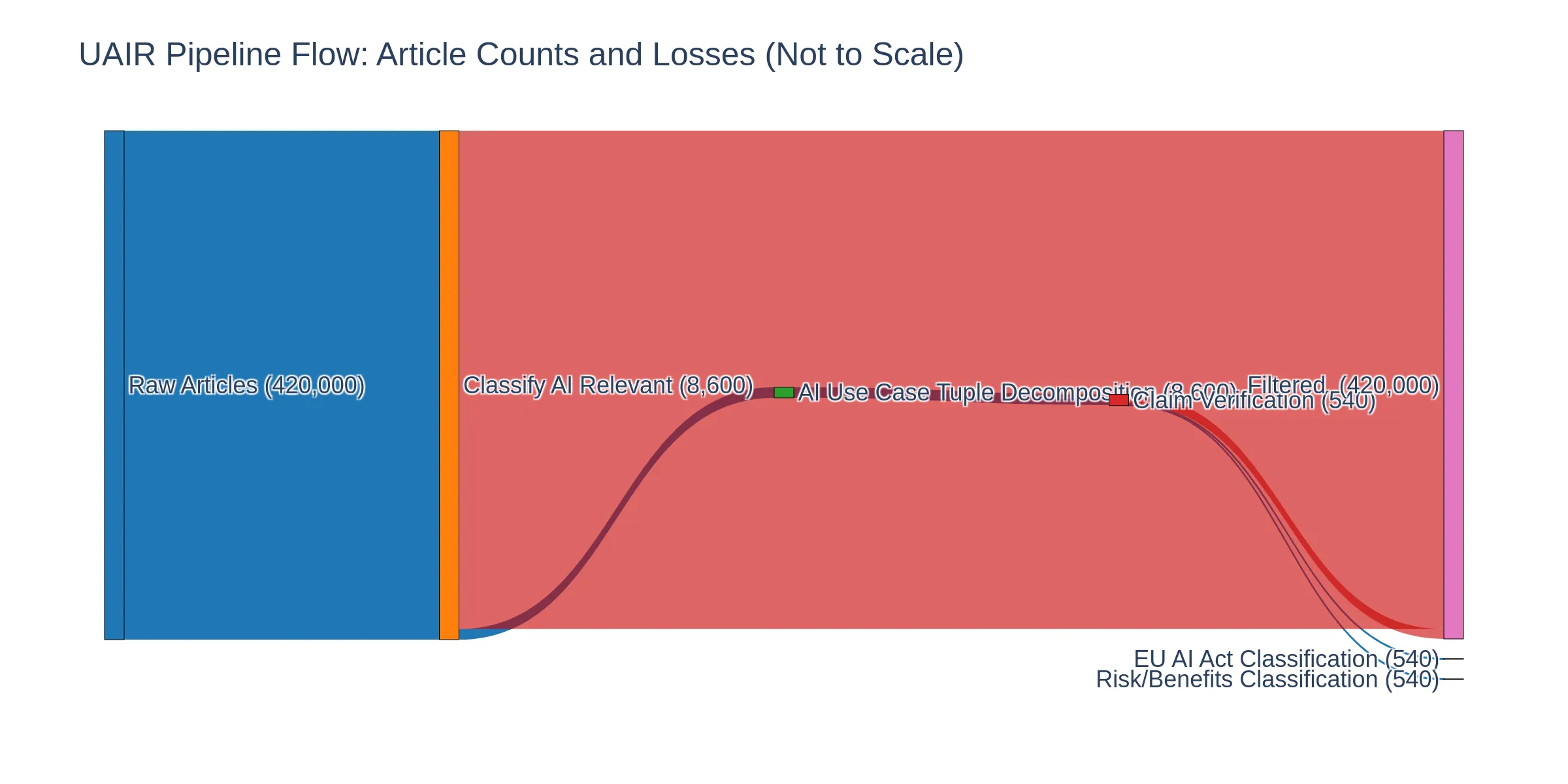
The UAIR pipeline processes articles through five sequential stages, with significant filtering occurring at classification and verification stages. Figure 2 visualizes the flow of articles through the pipeline using a Sankey diagram, showing how articles are filtered and processed at each stage.
The pipeline begins with 29,372 input articles from the US dataset. At the classification stage, articles are evaluated for relevance to AI risks using LLM-based binary classification. This stage filters the dataset to 578 relevant articles (1.97% retention), with 28,794 articles (98.0%) classified as not relevant and excluded from downstream processing. The classification stage serves as the primary filtering mechanism, removing articles that do not contain substantive AI-related content.
All 578 relevant articles proceed to the decomposition stage, where they are processed into structured tuples. This stage extracts 13 core fields capturing deployment context, actors, locations, and impacts. No articles are lost at this stage, as decomposition operates on all relevant articles regardless of information completeness (missing fields are explicitly tracked).
The verification stage applies semantic similarity and natural language inference models to validate extracted tuples against source article text. This stage represents the second major filtering point: of 578 decomposed articles, only 61 articles (10.5%) pass core tuple verification thresholds, with 517 articles (89.5%) failing verification and excluded from regulatory classification. The verification stage acts as a quality gate, ensuring that only tuples with sufficient evidence in the source text proceed to classification stages.
The final two stages—EU AI Act classification and risks/benefits assessment—operate on all 61 verified articles. These stages perform regulatory classification and impact assessment, producing structured outputs for policy analysis. While no articles are filtered at these stages, the EU AI Act classification flags 17 articles (27.9% of verified articles) as “too vague to process,” providing transparency about classification limitations.
Table 1 summarizes article counts, cumulative losses, stage-specific losses, and retention rates at each pipeline stage. The pipeline achieves a final retention rate of 0.21%, processing 61 articles from the original 29,372 inputs. This high filtering rate reflects the pipeline’s focus on high-quality, verifiable AI risk information suitable for regulatory analysis.
| Stage | Article Count | Cumulative Loss | Stage Loss | Retention Rate (%) |
|---|---|---|---|---|
| Input | 29,372 | 0 | — | 100.00 |
| Classify | 578 | 28,794 | 28,794 | 1.97 |
| Decompose | 578 | 28,794 | — | 1.97 |
| Verify | 61 | 29,311 | 517 | 0.21 |
| EU AI Act | 61 | 29,311 | — | 0.21 |
| Risk/Benefits | 61 | 29,311 | — | 0.21 |
Pipeline flow summary: article counts and retention rates at each stage. The pipeline processes 29,372 input articles, filtering to 578 relevant articles (1.97% retention) at classification, then further reducing to 61 verified articles (0.21% final retention) after verification.
Performance Characteristics
Pipeline performance varies by stage and dataset size. On a 2x RTX A6000 GPU setup:
-
Classification: Processes approximately 100–1000 articles/second depending on article length and batch size. Typical batch size: 16 articles, latency: 0.1–1.0 seconds per batch.
-
Decomposition: Processes approximately 10–50 articles/second due to longer context windows and more complex extraction. Typical batch size: 4 articles, latency: 0.5–2.0 seconds per batch.
-
Verification: CPU-bound process, processes approximately 100–500 tuples/second depending on article length and verification method. Can be parallelized across multiple CPU cores.
-
EU Act Classification: Similar to decomposition, processes approximately 10–50 articles/second with batch size 4.
-
Risks/Benefits: Similar performance to EU Act classification, with slightly longer processing times due to more complex output schemas.
Memory usage scales with batch size and context length. Typical memory footprint: 20–40GB GPU memory per GPU for 30B parameter models with 16k context, plus 10–30GB CPU memory for Ray object store and data processing.
Data Quality Metrics
The pipeline tracks several quality metrics automatically:
Classification Quality: Relevance rates (percentage of articles classified as relevant) vary by source and time period. Keyword pre-filtering typically filters out 20-30% of articles in our experimental datasets.
Extraction Quality: The missing field provides transparency about
information gaps.
Verification Quality: Verification acts as a quality gate for downstream classification stages, ensuring that extracted tuples actually match article intent and are about AI use cases.
Classification Coverage: Vague articles are explicitly flagged, rather than misclassified.
News Article Analysis Results
Analysis of the processed news articles reveals patterns in AI risk deployment across domains, temporal trends in media coverage, and regulatory risk distributions. The following tables and visualizations contextualize these findings within the broader landscape of AI risk reporting.
Deployment Domain Distribution
Table 2 presents the top 10 deployment domains by article count in the processed dataset. Public and private transportation dominates with 966 articles (16.7% of relevant articles), reflecting the high visibility of AI deployments in urban mobility systems, autonomous vehicles, and traffic management. Arts and Entertainment follows with 800 articles, highlighting media coverage of AI-generated content, deepfakes, and creative applications. Transport and Logistics (597 articles) and Education and vocational training (483 articles) round out the top domains, demonstrating the breadth of AI deployment across critical urban infrastructure sectors.
The domain distribution reflects both the prevalence of AI deployments in these sectors and the newsworthiness of incidents and developments in these areas. Transportation-related domains (Public and private transportation, Transport and Logistics) together account for 1,563 articles (27.0% of relevant articles), indicating that mobility and logistics represent a major focus of AI risk reporting in news media.
| Deployment domain | Num. articles |
|---|---|
| Deployment domain | Num. articles |
| Health and Healthcare | 76 |
| Media and Communication | 70 |
| Transport and Logistics | 53 |
| Social Media | 52 |
| Energy | 32 |
| Education and vocational training | 30 |
| Finance and Investment | 22 |
| Entrepreneurship | 22 |
| Urban Planning | 22 |
| Government Services and Administration | 22 |
Top 10 AI Deployment Domains by Article Count
Table 3 provides a detailed breakdown of risks, harms, and benefits reported for each of the top 10 deployment domains. The table illustrates the complexity of AI impacts across domains, showing that most deployments involve both potential benefits and risks. For example, Public and private transportation shows substantial benefits (781+ reported benefits) alongside significant risks (728+ potential risks) and documented harms (669+ actual harms), reflecting the dual nature of AI deployment in critical infrastructure systems.
The detailed breakdown reveals domain-specific patterns: Healthcare domains show high proportions of benefits related to diagnostic capabilities and patient care, while also documenting risks of misdiagnosis and privacy violations. Education domains demonstrate concerns about academic integrity and student development alongside benefits of personalized learning and accessibility. Finance domains highlight both fraud prevention benefits and discrimination risks in automated decision-making systems.
| Risks | Harms | Benefits |
|
|
|
| Risks | Harms | Benefits |
|
|
|
| Risks | Harms | Benefits |
|
|
|
| Risks | Harms | Benefits |
|
|
|
| Risks | Harms | Benefits |
|
|
|
| Risks | Harms | Benefits |
|
|
|
| Risks | Harms | Benefits |
|
|
|
| Risks | Harms | Benefits |
|
|
|
| Risks | Harms | Benefits |
|
|
|
| Risks | Harms | Benefits |
|
|
|
EU AI Act Risk Classifications by Domain
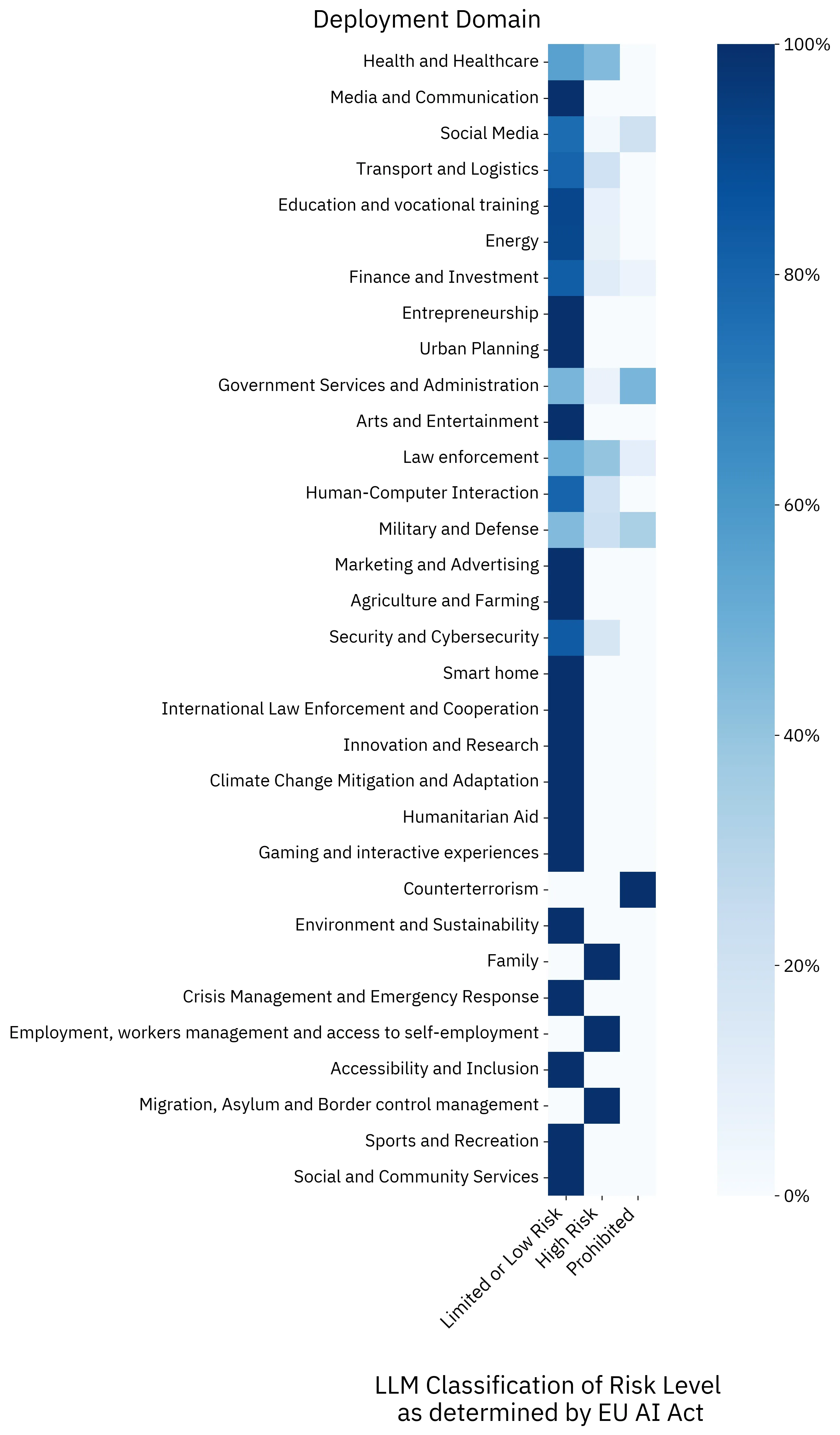
Figure 3 presents a heatmap showing the distribution of EU AI Act risk classifications across deployment domains identified in the news articles. The analysis reveals that High Risk classifications dominate in healthcare and law enforcement domains, reflecting the regulatory framework’s emphasis on protecting fundamental rights in these sensitive areas. Prohibited practices are rare but concentrated in specific domains such as biometric identification, where real-time remote biometric identification systems face strict limitations under the Act. The heatmap demonstrates how different domains exhibit distinct risk profiles, with Limited or Low Risk classifications more common in domains like transportation and logistics, where AI systems often serve as safety components rather than decision-making tools affecting individual rights.
The distribution patterns reflect both the nature of AI deployments reported in news media and the regulatory framework’s risk-based approach. Domains with higher public visibility and direct impact on individual rights—such as law enforcement, healthcare, and employment—show higher proportions of High Risk classifications, consistent with the EU AI Act’s focus on protecting fundamental rights in these contexts.
Temporal Trends in AI-Relevant News Coverage
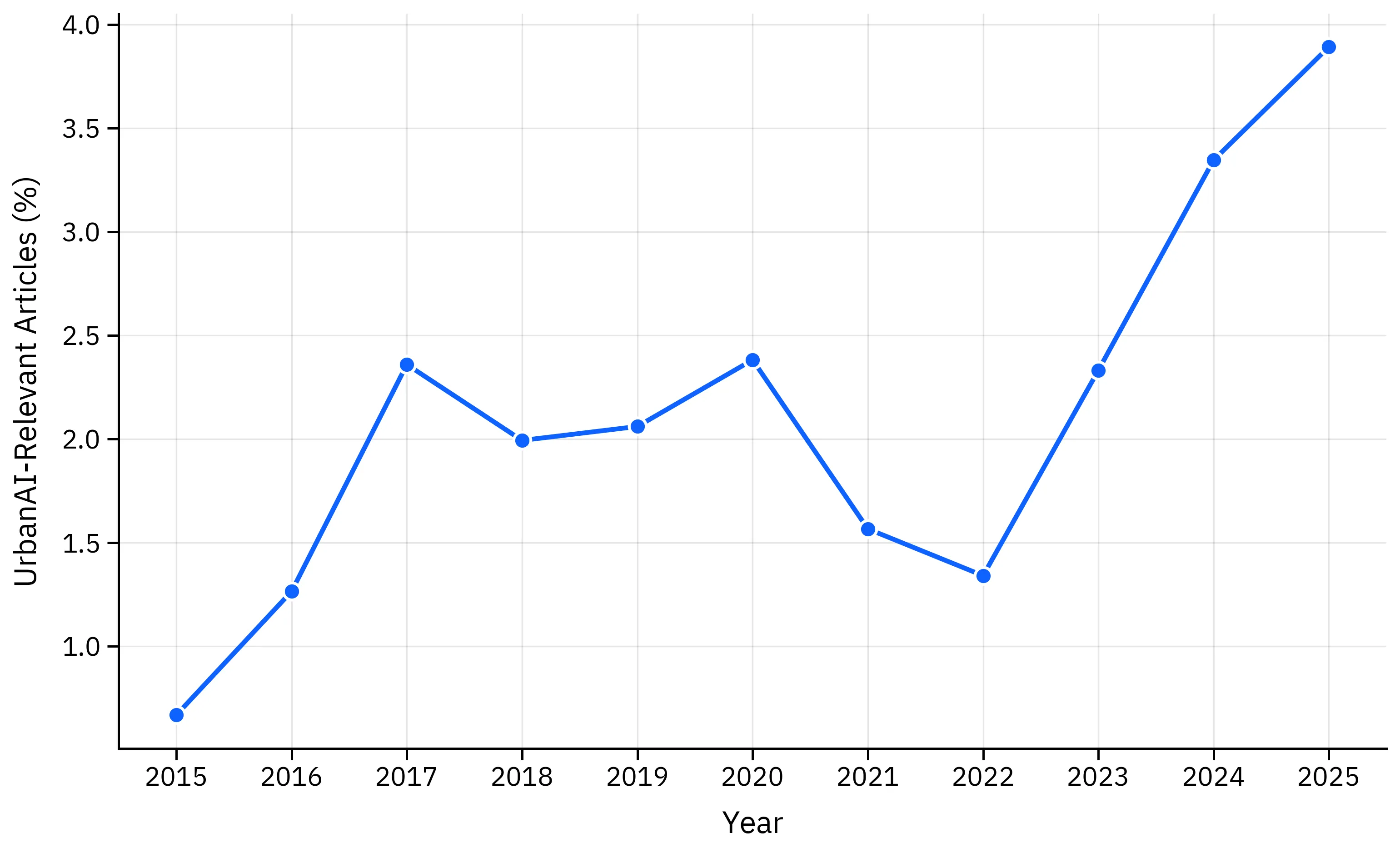
Figure 4 illustrates temporal trends in the fraction of articles classified as AI-relevant over time. The analysis reveals a steady increase in the proportion of news articles containing substantive AI-related content, reflecting both the growing deployment of AI systems across urban environments and increased media attention to AI-related incidents and developments. This trend suggests that AI risks and deployments are becoming more prominent in public discourse, with news media increasingly covering AI-related topics as these technologies become more pervasive in daily life.
The temporal analysis provides insights into how media coverage of AI risks has evolved, potentially reflecting both actual increases in AI deployment and incidents, as well as growing public awareness and media interest in AI-related topics. This trend has implications for risk monitoring and regulatory compliance, as increased coverage may indicate both greater AI adoption and heightened public scrutiny of AI systems.
Discussion
Design Decisions and Trade-offs
The UAIR pipeline makes several key design decisions that balance performance, accuracy, and maintainability:
Configuration-Driven Architecture: The use of Hydra for configuration management enables experimentation without code changes, but requires careful schema design to prevent configuration errors. The hierarchical config structure provides flexibility while maintaining consistency across pipeline variants. The trade-off is increased complexity in configuration debugging, mitigated by comprehensive validation and clear error messages.
Parquet as Intermediate Format: Persisting all intermediate results as Parquet files enables partial execution and result inspection, but increases storage requirements (typically 2–5x compared to streaming-only approaches). The trade-off favors reproducibility and debuggability over storage efficiency, which is acceptable given the value of result inspection and incremental processing for research workflows.
Guided Decoding vs. Post-Processing: Using vLLM’s guided decoding ensures schema compliance at generation time, eliminating the need for post-processing and reducing error rates from 5–10% (with post-processing) to less than 1%. However, it requires careful schema design, can slightly reduce generation flexibility, and adds computational overhead (approximately 10–15% slower generation). The accuracy benefits outweigh the performance cost for structured extraction tasks.
Verification Gating: Requiring core tuple verification before
classification ensures high-quality inputs but reduces coverage by
20–40% (depending on verification thresholds). The explicit
too_vague_to_process flag provides transparency about coverage gaps,
enabling users to understand and adjust thresholds based on their
quality/coverage trade-offs.
Multi-Stage vs. End-to-End: The five-stage design enables independent optimization, debugging, and partial execution, but increases complexity and potential for schema drift. Each stage can be tuned independently (batch sizes, model parameters, thresholds), providing flexibility at the cost of increased configuration complexity.
SLURM vs. Local Execution: SLURM integration enables
production-scale processing on shared clusters but adds complexity in
job management and debugging. Local execution (via launcher: null)
enables fast iteration but is limited by local resources. The system
supports both modes seamlessly, allowing development on local machines
and production runs on clusters.
Scalability Considerations
The pipeline is designed to scale from small test runs to production-scale processing:
Memory Efficiency: Ray Data’s lazy evaluation and streaming I/O enable processing datasets larger than available RAM. Object store sizing (90% of job memory) balances memory efficiency with data sharing needs.
GPU Utilization: vLLM’s continuous batching and tensor parallelism enable efficient GPU utilization. Memory utilization settings (0.8–0.9) balance throughput with stability, leaving headroom for memory spikes.
Distributed Execution: SLURM integration enables scaling across multiple nodes, though current implementation focuses on single-node multi-GPU setups. Future work could extend to multi-node Ray clusters.
Limitations and Future Work
Several limitations present opportunities for future improvement:
Multilingual Support: While models support multilingual text, prompt templates are primarily English-focused. Localized prompts could improve extraction quality for non-English articles.
Verification Model Selection: Current verification models (e5-base, mDeBERTa-base) are relatively small for accuracy/speed trade-offs. Larger models could improve verification accuracy but would increase computational costs.
Schema Evolution: Adding new fields to tuples requires coordinated updates across decomposition, verification, and downstream stages. A schema registry could facilitate versioning and migration.
Error Recovery: While the pipeline includes error handling, recovery from partial failures could be improved. Checkpointing and resume capabilities would enable more robust long-running executions.
Real-Time Processing: Current implementation focuses on batch processing. Streaming processing capabilities could enable near-real-time monitoring of AI risks as news articles are published.
Reproducibility and Open Science
The pipeline design emphasizes reproducibility:
Deterministic Execution: Temperature 0 for classification stages ensures deterministic outputs. Seed values are configurable for controlled randomness in verification and other stochastic components.
Experiment Tracking: W&B integration captures full configuration, compute metadata, and results, enabling experiment comparison and reproduction.
Version Control: Configuration files are version-controlled, and model paths are explicit, enabling exact reproduction of results.
Documentation: Comprehensive inline documentation and configuration comments facilitate understanding and modification.
Policy and Regulatory Applications
The pipeline outputs are designed to support policy analysis and regulatory monitoring:
EU AI Act Compliance: Classification outputs map directly to EU AI Act risk categories, enabling compliance monitoring and risk assessment at scale.
Trend Analysis: Temporal and geographic analysis of classifications can identify emerging risks and regulatory gaps.
Impact Assessment: Human rights and SDG impact assessments provide structured data for policy evaluation and stakeholder engagement.
Transparency: Verification scores and missing field tracking provide transparency about data quality and coverage limitations.
Conclusion
The UAIR pipeline provides a comprehensive, scalable system for extracting and classifying AI risk information from large-scale news collections. Its configuration-driven architecture, distributed processing capabilities, and structured outputs make it suitable for both research and policy applications. The system’s modular design enables extension and customization while maintaining consistency and reproducibility.
Appendices
1em 1em 1em
Relevance Classification Prompt
System Prompt
As a Senior Technology Specialist, you specialize in the latest developments in Artificial Intelligence (AI) technology. You focus on Responsible AI development and use. As part of this, you investigate real-world AI incidents from news articles and try to understand both the original AI uses as well as specific, sometimes malicious, instantiations of those uses that caused the incidents. In this pivotal role, you are entrusted with reviewing and cataloguing the diverse applications, use cases, and incidents of AI technology across multiple domains.
User Template
Read the following article chunk and answer strictly YES or NO to the question: Does this article describe a use of artificial intelligence technology?
[article_id={article_id} chunk={chunk_id}/{num_chunks}] {chunk_text}
Output Instructions
The model must return only “YES” or “NO”. The classification uses guided decoding with a choice constraint limiting outputs to “YES” or “NO,” ensuring deterministic binary classification without post-processing. This eliminates parsing errors and ensures consistent output format.
Configuration
The stage supports optional keyword-based pre-filtering to reduce computational costs by gating articles before LLM processing. The keyword regex matches AI-related terms including “artificial intelligence,” “machine learning,” “neural network,” “large language model,” and common model names (GPT, Claude, Gemini, etc.).
Batch size is typically 16 articles per batch, GPU memory utilization 0.8, and maximum model context length 8,192 tokens. The stage outputs two datasets: all articles with relevance scores, and a filtered set containing only relevant articles. On the US dataset, this filtered set contains 578 articles (1.97% of 29,372 input articles) for downstream processing.
1em 1em 1em
Tuple Decomposition Prompt
System Prompt
You are an expert artificial intelligence safety researcher trained in extracting and summarizing urban AI risks from news articles. Given a single news article that pertains to an urban artificial intelligence (AI) use case, extract a structured template of the use, including the deployment domain, deployment purpose, deployment capability, identity of the AI deployer, identity of the AI subject, identity of the AI developer, location of the AI deployer, location of the AI subject, and date & time of the event. For any field that is missing, vague, unclear, or not specified, set it to null and list it under missing. You can provide multiple values for a field.
User Template
You will be provided input with the text of a news article randomly sampled from a global news database. Only focus on the article narrative, not advertisements or other scraping artifacts. Based on the input information, formulate the following outputs:
I) Original Intended AI Use
You need to focus on the original AI use, as it might have been intended for potentially beneficial applications, even if it has been misused or its unintended applications resulted in the incident. DO NOT FILL IN THE FIELDS IF THEY ARE NOT SPECIFIED IN THE INPUT ARTICLE TEXT; instead, list them under “missing”.
The definition of the use must contain specific details about how the technology is used by using action verbs that clearly describe the actions, activities, or processes of the uses. The level of specificity should be general and not on the very concrete instance. For each of these uses, you must output the following 10 elements each in less than 7 words:
-
Domain: The domain that represents the area or sector in which the AI system is intended to be used.
-
Purpose: The purpose or objective that is intended to be accomplished by using an AI system.
-
Capability: The capability of the AI system that enables the realization of its purpose and reflects the technological capability.
-
Deployment Space: The type of space in which the use took place. Can be one of: Online space; Publicly accessible space; Not publicly accessible space.
-
AI Deployer: The entity or individual in charge of deploying and managing the AI system, including individuals, organizations, corporations, public authorities, and agencies responsible for its operation and management. Even if the deployer of a general intended use is specified, such as the AI system provider, or if a specific person or entity misused the original use, do not name that entity directly but instead output the more general intended original deployer (e.g., “Social media company” instead of “Company X”).
-
Location of AI Deployer: The location of the AI deployer, including countries, cities, or regions.
-
AI Subject: The entity or individual directly affected by the use of the AI system, experiencing its effects and consequences. They interact with or are impacted by the AI system’s processes, decisions, or outcomes. If the general AI Deployer of the original intended AI use is specified, you should include it. If a specific person or entity were intentionally or unintentionally harmed but does not represent well the general deployer, output instead the general intended original deployer (e.g., “Social media users” instead of “John Doe”).
-
Location of AI Subject: The location of the AI subject, including countries, cities, or regions.
-
Date & Time of Event: The date and time of the event, including the year, month, day, hour, and minute.
-
Missing: List of missing or uncertain fields.
Ensure that each concept is specific and easy to understand for non-experts. Avoid duplicate purposes or objectives and use clear and precise language to describe the uses’ concepts.
Capability Formatting
For the “Capability”, write it by combining action verbs in gerund form (i.e., ending with “ing”), inferences and data, entity or metric.
-
Action verbs clearly describe the actions, activities, or processes taken by the AI system, e.g., identify. Choose the most suitable action verb from the following list:
-
(A) Estimating (e.g., Rating, Grading, Measuring, Assessing)
-
(B) Forecasting (e.g., Predicting, Guessing, Speculating)
-
(C) Comparing (e.g., Ranking, Ordering, Finding Best, Finding Cheapest, Recommending)
-
(D) Detecting (e.g., Monitoring, Sensing, Noticing, Classifying, Discriminating)
-
(E) Identifying (e.g., Recognizing, Discerning, Finding, Classifying, Perceiving)
-
(F) Discovering (e.g., Extracting, Noticing, Organizing, Clustering, Grouping, Connecting, Revealing)
-
(G) Generating (e.g., Making, Composing, Constructing, Creating, Authoring)
-
(H) Acting (e.g., Doing, Executing, Playing, Going, Learning, Operating)
-
-
Inference clearly describes the output or conclusion drawn by the AI system based on the data it processes, e.g., crop yield, floods, trend, anomaly, wildfires, pattern, and probability
-
Data, Entity or Metric clearly describes the source, type, or nature of the data used by the AI system, e.g., from an optical camera, from an infrared camera, user input, sensor readings, transaction records, biometric data, environmental data, social media posts, geographical information, medical records, and financial metrics.
For “Purpose”, write it also in a gerund verb form (i.e., ending with “ing”).
Double-check that you are outputting realistic, i.e., plausible, meaningful, and useful uses.
II) Specific AI Risks
Describe the specific AI risks that are mentioned in the input. Format each risk as one sentence, starting with the concrete risk if specified, or else your identified/inferred risk. Follow this by a verb in past tense specifying how it was mentioned, and then “due to” and the specific reason (e.g., unintended use of the AI system, malfunctioning, misuse, technical capability risk or failure).
For this part of the output, unlike the general AI use concepts, you must use the specific and concrete parties involved if they were named in the input (e.g., “Company X” instead of “Social media company” and “John Doe” instead of “social media users”). If the parties are not named in the input, use general terms without making up connections.
List as many distinct risks as you can clearly identify from the incident, but do not duplicate risks if the same or a similar risk affected multiple parties. Instead, include all those parties in a single risk description. Be specific and name any parties involved—both the at-risk ones and the AI deployers/providers—but only if they are listed in the input. End each risk description with a full stop (period).
III) Specific AI Harms
Describe the specific AI harms that occurred. Format each harm as one sentence, starting with the concrete harmed parties if specified, or else your identified/inferred harmed parties or subjects. Follow this by a verb in past tense specifying how they were harmed, and then “due to” and the specific reason (e.g., unintended use of the AI system, malfunctioning, misuse, technical capability risk or failure).
For this part of the output, unlike the general AI use concepts, you must use the specific and concrete parties involved if they were named in the input (e.g., “Company X” instead of “Social media company” and “John Doe” instead of “social media users”). If the parties are not named in the input, use general terms without making up connections.
List as many distinct harms as you can clearly identify from the incident, but do not duplicate harms if the same or a similar harm affected multiple parties. Instead, include all those parties in a single harm description. Be specific and name any parties involved—both the harmed ones and the AI deployers/providers—but only if they are listed in the input. End each harm description with a full stop (period).
IV) Specific AI Benefits
Describe the specific AI benefits that are mentioned in the input. Format each benefit as one sentence, starting with the concrete benefit if specified, or else your identified/inferred benefit. Follow this by a verb in past tense specifying how it was mentioned, and then “due to” and the specific reason (e.g., unintended use of the AI system, malfunctioning, misuse, technical capability risk or failure).
For this part of the output, unlike the general AI use concepts, you must use the specific and concrete parties involved if they were named in the input (e.g., “Company X” instead of “Social media company” and “John Doe” instead of “social media users”). If the parties are not named in the input, use general terms without making up connections.
List as many distinct benefits as you can clearly identify from the incident, but do not duplicate benefits if the same or a similar benefit affected multiple parties. Instead, include all those parties in a single benefit description. Be specific and name any parties involved—both the benefited ones and the AI deployers/providers—but only if they are listed in the input. End each benefit description with a full stop (period).
Important: Double-check your whole output and ensure that the AI use is described in general terms, while the benefits are described in specific terms.
Output Format
The extraction must be returned as a correctly formatted JSON document with the following structure:
{
    "deployment_domain": "...",
    "deployment_purpose": "...",
    "deployment_capability": "...",
    "deployment_space": "...",
    "identity_of_ai_deployer": "...",
    "location_of_ai_deployer": "...",
    "identity_of_ai_subject": "...",
    "location_of_ai_subject": "...",
    "identity_of_ai_developer": "...",
    "date_and_time_of_event": "...",
    "missing": [...],
    "list_of_harms_that_occurred": [...],
    "list_of_risks_that_occurred": [...],
    "list_of_benefits_that_occurred": [...]
}
The extraction uses guided decoding with a JSON schema generated from a
Pydantic model. The schema defines field types (strings, enums, arrays)
and required fields. Schema references ($ref) are inlined for xgrammar
compatibility. The guided decoding configuration enforces strict schema
compliance (disable_fallback: true,
disable_additional_properties: true), ensuring outputs conform to the
expected structure without post-processing.
Ensure to output only the correctly formatted JSON and nothing else.
Input
Article: {article_text}
1em 1em 1em
Tuple Verification Methodology
Overview
The verification stage validates extracted tuples against source article text using a combination of semantic similarity and natural language inference (NLI). Unlike other pipeline stages that use LLM prompts, verification employs specialized embedding and NLI models to assess whether extracted claims are supported by evidence in the source text.
Verification Models
Embedding Model
The system uses intfloat/e5-base, a multilingual embedding model with E5-style query/passage prefixes. Text is encoded with mean pooling over token embeddings, normalized to unit vectors, and compared via cosine similarity. The model supports batch encoding for efficiency.
NLI Model
The system uses mDeBERTa-v3-base-xnli-multilingual for three-way classification (entailment, neutral, contradiction). The model handles multilingual text and outputs probability distributions over the three classes. Label indices are resolved dynamically from model config to handle different model architectures.
Verification Process
The verification method employs a “combo” approach that combines similarity scores, entailment probabilities, and contradiction detection. The process for each tuple field proceeds as follows:
-
Text Preprocessing: Split article text into sentences for granular matching.
-
Encoding: Encode the extracted claim (tuple field value) and all article sentences using the embedding model. Both claim and sentences are encoded with appropriate prefixes (query for claim, passage for sentences).
-
Similarity Matching: Compute cosine similarities between the claim embedding and all sentence embeddings. Identify the top-k most relevant text spans (typically $
k=5$) from the article for each tuple field. -
Natural Language Inference: Run NLI on claim-premise pairs, where the premise is each of the top-k matching sentences. The NLI model outputs probabilities for entailment, neutral, and contradiction classes.
-
Score Combination: Combine scores using configurable thresholds. The “combo” method requires:
-
Similarity $
\geq 0.55$ -
Entailment probability $
\geq 0.85$ -
Contradiction probability $
\leq 0.05$
-
-
Field Verification: A tuple field is considered verified if at least one of the top-k sentences meets all three thresholds.
-
Core Tuple Verification: A core tuple is considered verified if its key fields (domain, purpose, capability, deployer, subject) all meet the verification thresholds.
Windowing (Optional)
Optional windowing groups consecutive sentences into windows (configurable size and stride) to handle multi-sentence evidence spans. This is particularly useful for complex claims that span multiple sentences. When windowing is enabled, the system:
-
Groups sentences into overlapping windows (default window size: 5 sentences, stride: 2)
-
Encodes each window as a single passage
-
Computes similarities and runs NLI on claim-window pairs
-
Selects the best-matching window for verification
Configuration Parameters
Default thresholds are:
-
Similarity threshold: $
\geq 0.55$ -
Entailment threshold: $
\geq 0.85$ -
Contradiction threshold: $
\leq 0.05$ -
Top-k sentences: 5
-
Windowing: disabled by default
-
Window size: 5 sentences (when enabled)
-
Window stride: 2 sentences (when enabled)
Output
The verification stage produces verification scores and flags for each tuple field:
-
sim_score— Cosine similarity score between claim and best-matching sentence -
ent_prob— Entailment probability from NLI model -
contra_prob— Contradiction probability from NLI model -
verified— Boolean flag indicating if field meets all thresholds -
core_tuple_verified— Boolean flag indicating if all core fields (domain, purpose, capability, deployer, subject) are verified
On the US dataset, 61 of 578 decomposed articles (10.5%) pass core tuple verification.
1em 1em 1em
EU AI Act Risk Classification Prompt
System Prompt
You are an experienced regulatory compliance specialist who works in the field of artificial intelligence (AI) technology regulation. You are thoughtful, decisive, experienced and conscientious. You have access to the entirety of the EU AI Act and its amendments, which outline how various AI technologies are to be regulated and risk-classified within the European Union.
Classification Instructions
Classify the following urban AI use by utilizing a three-tier classification: 1) Prohibited, 2) High Risk, and 3) Limited or Low Risk.
Four Classification Steps
-
Write a Brief Description: Write a brief description of the urban AI usage, using similar language to the EU AI Act. The description should start with “The urban AI usage intended to be used…”, and be written in a single sentence.
-
Determine Risk Level: Determine whether the urban AI usage is Prohibited or of High Risk, providing the exact text from the EU AI Act and explaining the reasoning. Be very strict and verify the reasoning. Assume High Risk unless there is clear evidence that it is Prohibited. Pay particular attention to the subject and user of the urban AI usage, as this is critical for classification. Ensure that the subject and user align with the text. They are very important. Also, ensure that you understand the purpose and the capability of the urban AI usage as this is highly critical for the risk classification. For example, the capability to verify patient identities by using urban AI usage implies the use of biometric identification of patients. Be aware of these and similar cases.
-
Review Amendments: Go through all the amendments to the EU AI Act and ensure that nothing has changed that would affect the classification. If something has changed, update the classification accordingly and explicitly reference the amendment that most closely resembles the urban AI usage. The amendments can be found under the text: “Here are some important amendments to the Act:”
-
Default Classification: If the urban AI usage is neither Prohibited nor High Risk, classify it as Limited or Low Risk.
It is of utmost importance to exercise precision and make accurate judgments when classifying the risk associated with the urban AI usage. Please carefully consider all the regulations listed below during the risk classification of the urban AI usage.
Article 5: Prohibited Artificial Intelligence Practices
Paragraph 1: Prohibited Practices
The following artificial intelligence practices shall be prohibited:
-
The placing on the market, putting into service or use of an AI system that deploys subliminal techniques beyond a person’s consciousness or purposefully manipulative or deceptive techniques, with the objective to or the effect of materially distorting a person’s or a group of persons’ behaviour by appreciably impairing the person’s ability to make an informed decision, thereby causing the person to take a decision that that person would not have otherwise taken in a manner that causes or is likely to cause that person, another person or group of persons significant harm;
-
The placing on the market, putting into service or use of an AI system that exploits any of the vulnerabilities of a person or a specific group of persons due to their age, disability or a specific social or economic situation, with the objective to or the effect of materially distorting the behaviour of that person or a person pertaining to that group in a manner that causes or is reasonably likely to cause that person or another person significant harm;
-
The placing on the market or putting into service for this specific purpose, or use of biometric categorisation systems that categorise individually natural persons based on their biometric data to deduce or infer their race, political opinions, trade union membership, religious or philosophical beliefs, sex life or sexual orientation. This prohibition does not cover any labelling or filtering of lawfully acquired biometric datasets, such as images, based on biometric data or categorizing of biometric data in the area of law enforcement;
-
The placing on the market, putting into service or use of AI systems for the evaluation or classification of natural persons or groups thereof over a certain period of time based on their social behaviour or known, inferred or predicted personal or personality characteristics, with the social score leading to either or both of the following:
-
detrimental or unfavourable treatment of certain natural persons or whole groups thereof in social contexts that are unrelated to the contexts in which the data was originally generated or collected;
-
detrimental or unfavourable treatment of certain natural persons or groups thereof that is unjustified or disproportionate to their social behaviour or its gravity;
-
-
The use of ‘real-time’ remote biometric identification systems in publicly accessible spaces for the purpose of law enforcement unless and in as far as such use is strictly necessary for one of the following objectives:
-
the targeted search for specific victims of abduction, trafficking in human beings and sexual exploitation of human beings as well as search for missing persons;
-
the prevention of a specific, substantial and imminent threat to the life or physical safety of natural persons or a genuine and present or genuine and foreseeable threat of a terrorist attack;
-
the localisation or identification of a person suspected of having committed a criminal offence, for the purposes of conducting a criminal investigation, prosecution or executing a criminal penalty for offences, referred to in Annex II and punishable in the Member State concerned by a custodial sentence or a detention order for a maximum period of at least four years.
This paragraph is without prejudice to the provisions in Article 9 of the GDPR for the processing of biometric data for purposes other than law enforcement;
-
-
The placing on the market, putting into service for this specific purpose, or use of an AI system for making risk assessments of natural persons in order to assess or predict the risk of a natural person to commit a criminal offence, based solely on the profiling of a natural person or on assessing their personality traits and characteristics; This prohibition shall not apply to AI systems used to support the human assessment of the involvement of a person in a criminal activity, which is already based on objective and verifiable facts directly linked to a criminal activity;
-
The placing on the market, putting into service for this specific purpose, or use of AI systems that create or expand facial recognition databases through the untargeted scraping of facial images from the internet or CCTV footage;
-
The placing on the market, putting into service for this specific purpose, or use of AI systems to infer emotions of a natural person in the areas of workplace and education institutions except in cases where the use of the AI system is intended to be put in place or into the market for medical or safety reasons;
Paragraph 1a
This Article shall not affect the prohibitions that apply where an artificial intelligence practice infringes other Union law.
Paragraphs 2–6: Real-Time Remote Biometric Identification
Paragraph 2. The use of ‘real-time’ remote biometric identification systems in publicly accessible spaces for the purpose of law enforcement for any of the objectives referred to in paragraph 1 point d) shall only be deployed for the purposes under paragraph 1, point d) to confirm the specifically targeted individual’s identity and it shall take into account the following elements:
-
the nature of the situation giving rise to the possible use, in particular the seriousness, probability and scale of the harm caused in the absence of the use of the system;
-
the consequences of the use of the system for the rights and freedoms of all persons concerned, in particular the seriousness, probability and scale of those consequences.
In addition, the use of ‘real-time’ remote biometric identification systems in publicly accessible spaces for the purpose of law enforcement for any of the objectives referred to in paragraph 1 point d) shall comply with necessary and proportionate safeguards and conditions in relation to the use in accordance with national legislations authorizing the use thereof, in particular as regards the temporal, geographic and personal limitations. The use of the ‘real-time’ remote biometric identification system in publicly accessible spaces shall only be authorised if the law enforcement authority has completed a fundamental rights impact assessment as provided for in Article 27 and has registered the system in the database according to Article 49. However, in duly justified cases of urgency, the use of the system may be commenced without the registration, provided that the registration is completed without undue delay.
Paragraph 3. As regards paragraphs 1, point (d) and 2, each use for the purpose of law enforcement of a ‘real-time’ remote biometric identification system in publicly accessible spaces shall be subject to a prior authorisation granted by a judicial authority or an independent administrative authority whose decision is binding of the Member State in which the use is to take place, issued upon a reasoned request and in accordance with the detailed rules of national law referred to in paragraph 4. However, in a duly justified situation of urgency, the use of the system may be commenced without an authorisation provided that, such authorisation shall be requested without undue delay, at the latest within 24 hours. If such authorisation is rejected, its use shall be stopped with immediate effect and all the data, as well as the results and outputs of this use shall be immediately discarded and deleted.
Paragraph 3a. Without prejudice to paragraph 3, each use of a ‘real-time’ remote biometric identification system in publicly accessible spaces for law enforcement purposes shall be notified to the relevant market surveillance authority and the national data protection authority in accordance with the national rules referred to in paragraph 4.
Paragraph 4. A Member State may decide to provide for the possibility to fully or partially authorise the use of ‘real-time’ remote biometric identification systems in publicly accessible spaces for the purpose of law enforcement within the limits and under the conditions listed in paragraphs 1, point (d), 2 and 3.
Paragraph 5. National market surveillance authorities and the national data protection authorities of Member States that have been notified of the use of ‘real-time’ remote biometric identification systems in publicly accessible spaces for law enforcement purposes pursuant to paragraph 3a shall submit to the Commission annual reports on such use.
Paragraph 6. The Commission shall publish annual reports on the use of ‘real-time’ remote biometric identification systems in publicly accessible spaces for law enforcement purposes based on aggregated data in Member States based on the annual reports referred to in paragraph 5.
Definition: Publicly Accessible Space
For the purposes of this Regulation the notion of publicly accessible space should be understood as referring to any physical place that is accessible to an undetermined number of natural persons, and irrespective of whether the place in question is privately or publicly owned and irrespective of the activity for which the place may be used, such as commerce (for instance, shops, restaurants, cafés), services (for instance, banks, professional activities, hospitality), sport (for instance, swimming pools, gyms, stadiums), transport (for instance, bus, metro and railway stations, airports, means of transport), entertainment (for instance, cinemas, theatres, museums, concert and conference halls) leisure or otherwise (for instance, public roads and squares, parks, forests, playgrounds).
A place should be classified as publicly accessible also if, regardless of potential capacity or security restrictions, access is subject to certain predetermined conditions, which can be fulfilled by an undetermined number of persons, such as purchase of a ticket or title of transport, prior registration or having a certain age. By contrast, a place should not be considered publicly accessible if access is limited to specific and defined natural persons through either Union or national law directly related to public safety or security or through the clear manifestation of will by the person having the relevant authority on the place.
The factual possibility of access alone (e.g. an unlocked door, an open gate in a fence) does not imply that the place is publicly accessible in the presence of indications or circumstances suggesting the contrary (e.g. signs prohibiting or restricting access). Company and factory premises as well as offices and workplaces that are intended to be accessed only by relevant employees and service providers are places that are not publicly accessible. Publicly accessible spaces should not include prisons or border control.
Some other areas may be composed of both not publicly accessible and publicly accessible areas, such as the hallway of a private residential building necessary to access a doctor’s office or an airport. Online spaces are not covered either, as they are not physical spaces. Whether a given space is accessible to the public should however be determined on a case-by-case basis, having regard to the specificities of the individual situation at hand.
Article 6: Classification Rules for High-Risk AI Systems
Paragraph 1: Safety Components
Irrespective of whether an AI system is placed on the market or put into service independently from the products referred to in points (a) and (b), that AI system shall be considered high-risk where both of the following conditions are fulfilled:
-
the AI system is intended to be used as a safety component of a product, or the AI system is itself a product, covered by the Union harmonisation legislation listed in Annex I;
-
the product whose safety component pursuant to point (a) is the AI system, or the AI system itself as a product, is required to undergo a third party conformity assessment, with a view to the placing on the market or putting into service of that product pursuant to the Union harmonisation legislation listed in Annex I.
Paragraph 2: Annex III High-Risk Systems
In addition to the high-risk AI systems referred to in paragraph 1, AI systems referred to in Annex III shall also be considered high-risk.
Paragraph 2a: Derogation from High-Risk Classification
By derogation from paragraph 2 AI systems shall not be considered as high risk if they do not pose a significant risk of harm, to the health, safety or fundamental rights of natural persons, including by not materially influencing the outcome of decision making. This shall be the case if one or more of the following criteria are fulfilled:
-
the AI system is intended to perform a narrow procedural task;
-
the AI system is intended to improve the result of a previously completed human activity;
-
the AI system is intended to detect decision-making patterns or deviations from prior decision-making patterns and is not meant to replace or influence the previously completed human assessment, without proper human review; or
-
the AI system is intended to perform a preparatory task to an assessment relevant for the purpose of the use cases listed in Annex III.
Notwithstanding first subparagraph of this paragraph, an AI system shall always be considered high-risk if the AI system performs profiling of natural persons.
Paragraph 2b: Documentation Requirements
A provider who considers that an AI system referred to in Annex III is not high-risk shall document its assessment before that system is placed on the market or put into service. Such provider shall be subject to the registration obligation set out in Article 49(1a). Upon request of national competent authorities, the provider shall provide the documentation of the assessment.
Paragraph 2c: Commission Guidelines
The Commission shall, after consulting the AI Board, and no later than [18 months] after the entry into force of this Regulation, provide guidelines specifying the practical implementation of this article completed by a comprehensive list of practical examples of high risk and non-high risk use cases on AI systems pursuant to Article 82b.
Paragraph 2d: Delegated Acts
The Commission is empowered to adopt delegated acts in accordance with Article 97 to amend the criteria laid down in points a) to d) of the first subparagraph of paragraph 2a. The Commission may adopt delegated acts adding new criteria to those laid down in points a) to d) of the first subparagraph of paragraph 2a, or modifying them, only where there is concrete and reliable evidence of the existence of AI systems that fall under the scope of Annex III but that do not pose a significant risk of harm to the health, safety and fundamental rights.
Annex I: Union Harmonisation Legislation
Part I Section A: New Legislative Framework
-
Directive 2006/42/EC on machinery (as repealed by the Machinery Regulation)
-
Directive 2009/48/EC on the safety of toys
-
Directive 2013/53/EU on recreational craft and personal watercraft
-
Directive 2014/33/EU on lifts and safety components for lifts
-
Directive 2014/34/EU on equipment and protective systems for potentially explosive atmospheres
-
Directive 2014/53/EU on radio equipment
-
Directive 2014/68/EU on pressure equipment
-
Regulation (EU) 2016/424 on cableway installations
-
Regulation (EU) 2016/425 on personal protective equipment
-
Regulation (EU) 2016/426 on appliances burning gaseous fuels
-
Regulation (EU) 2017/745 on medical devices
-
Regulation (EU) 2017/746 on in vitro diagnostic medical devices
Part II Section B: Other Union Harmonisation Legislation
-
Regulation (EC) No 300/2008 on civil aviation security
-
Regulation (EU) No 168/2013 on two- or three-wheel vehicles and quadricycles
-
Regulation (EU) No 167/2013 on agricultural and forestry vehicles
-
Directive 2014/90/EU on marine equipment
-
Directive (EU) 2016/797 on the interoperability of the rail system
-
Regulation (EU) 2018/858 on motor vehicles and their trailers
-
Regulation (EU) 2019/2144 on type-approval requirements for motor vehicles
-
Regulation (EU) 2018/1139 on civil aviation and European Union Aviation Safety Agency (for unmanned aircraft)
Annex II: List of Criminal Offences
Criminal offences referred to in Article 5(1)(iii):
-
Terrorism
-
Trafficking in human beings
-
Sexual exploitation of children and child pornography
-
Illicit trafficking in narcotic drugs and psychotropic substances
-
Illicit trafficking in weapons, munitions and explosives
-
Murder
-
Grievous bodily injury
-
Illicit trade in human organs and tissue
-
Illicit trafficking in nuclear or radioactive materials
-
Kidnapping, illegal restraint and hostage-taking
-
Crimes within the jurisdiction of the International Criminal Court
-
Unlawful seizure of aircraft/ships
-
Rape
-
Environmental crime
-
Organised or armed robbery
-
Sabotage
-
Participation in a criminal organisation involved in one or more offences listed above
Annex III: High-Risk AI Systems
High-risk AI systems pursuant to Article 6(2) are the AI systems listed in any of the following areas:
1. Biometrics
Insofar as their use is permitted under relevant Union or national law:
-
Remote biometric identification systems. This shall not include AI systems intended to be used for biometric verification whose sole purpose is to confirm that a specific natural person is the person he or she claims to be;
-
AI systems intended to be used for biometric categorisation, according to sensitive or protected attributes or characteristics based on the inference of those attributes or characteristics;
-
AI systems intended to be used for emotion recognition.
2. Critical Infrastructure
- AI systems intended to be used as safety components in the management and operation of critical digital infrastructure, road traffic and the supply of water, gas, heating and electricity.
3. Education and Vocational Training
-
AI systems intended to be used to determine access or admission or to assign natural persons to educational and vocational training institutions at all levels;
-
AI systems intended to be used to evaluate learning outcomes, including when those outcomes are used to steer the learning process of natural persons in educational and vocational training institutions at all levels;
-
AI systems intended to be used for the purpose of assessing the appropriate level of education that individual will receive or will be able to access, in the context of/within education and vocational training institution;
-
AI systems intended to be used for monitoring and detecting prohibited behaviour of students during tests in the context of/within education and vocational training institutions.
4. Employment, Workers Management and Access to Self-Employment
-
AI systems intended to be used for recruitment or selection of natural persons, notably to place targeted job advertisements, to analyse and filter job applications, and to evaluate candidates;
-
AI intended to be used to make decisions affecting terms of the work related relationships, promotion and termination of work-related contractual relationships, to allocate tasks based on individual behaviour or personal traits or characteristics and to monitor and evaluate performance and behaviour of persons in such relationships.
5. Access to and Enjoyment of Essential Private and Public Services
-
AI systems intended to be used by public authorities or on behalf of public authorities to evaluate the eligibility of natural persons for essential public assistance benefits and services, including healthcare services, as well as to grant, reduce, revoke, or reclaim such benefits and services;
-
AI systems intended to be used to evaluate the creditworthiness of natural persons or establish their credit score, with the exception of AI systems used for the purpose of detecting financial fraud;
-
AI systems intended to evaluate and classify emergency calls by natural persons or to be used to dispatch, or to establish priority in the dispatching of emergency first response services, including by police, firefighters and medical aid, as well as of emergency healthcare patient triage systems;
-
AI systems intended to be used for risk assessment and pricing in relation to natural persons in the case of life and health insurance.
6. Law Enforcement
Insofar as their use is permitted under relevant Union or national law:
-
AI systems intended to be used by or on behalf of law enforcement authorities, or by Union institutions, agencies, offices or bodies in support of law enforcement authorities or on their behalf to assess the risk of a natural person to become a victim of criminal offences;
-
AI systems intended to be used by or on behalf of law enforcement authorities or by Union institutions, bodies and agencies in support of law enforcement authorities as polygraphs and similar tools;
-
AI systems intended to be used by or on behalf of law enforcement authorities, or by Union institutions, agencies, offices or bodies in support of law enforcement authorities to evaluate the reliability of evidence in the course of investigation or prosecution of criminal offences;
-
AI systems intended to be used by law enforcement authorities or on their behalf or by Union institutions, agencies, offices or bodies in support of law enforcement authorities for assessing the risk of a natural person of offending or re-offending not solely based on profiling of natural persons as referred to in Article 3(4) of Directive (EU) 2016/680 or to assess personality traits and characteristics or past criminal behaviour of natural persons or groups;
-
AI systems intended to be used by or on behalf of law enforcement authorities or by Union agencies institutions, agencies, offices or bodies in support of law enforcement authorities for profiling of natural persons as referred to in Article 3(4) of Directive (EU) 2016/680 in the course of detection, investigation or prosecution of criminal offences;
7. Migration, Asylum and Border Control Management
Insofar as their use is permitted under relevant Union or national law:
-
AI systems intended to be used by competent public authorities as polygraphs and similar tools;
-
AI systems intended to be used by or on behalf of competent public authorities or by Union agencies, offices or bodies to assess a risk, including a security risk, a risk of irregular migration, or a health risk, posed by a natural person who intends to enter or has entered into the territory of a Member State;
-
AI systems intended to be used by or on behalf of competent public authorities or by Union agencies, offices or bodies to assist competent public authorities for the examination of applications for asylum, visa and residence permits and associated complaints with regard to the eligibility of the natural persons applying for a status, including related assessment of the reliability of evidence;
-
AI systems intended to be used by or on behalf of competent public authorities, including Union agencies, offices or bodies, in the context of migration, asylum and border control management, for the purpose of detecting, recognising or identifying natural persons with the exception of verification of travel documents.
8. Administration of Justice and Democratic Processes
-
AI systems intended to be used by a judicial authority or on their behalf to assist a judicial authority in researching and interpreting facts and the law and in applying the law to a concrete set of facts or used in a similar way in alternative dispute resolution;
-
AI systems intended to be used for influencing the outcome of an election or referendum or the voting behaviour of natural persons in the exercise of their vote in elections or referenda. This does not include AI systems whose output natural persons are not directly exposed to, such as tools used to organise, optimise and structure political campaigns from an administrative and logistic point of view;
Article 7: Amendments to Annex III
Paragraph 1: Adding or Modifying Use Cases
The Commission is empowered to adopt delegated acts in accordance with Article 97 to amend Annex III by adding or modifying use cases of high-risk AI systems where both of the following conditions are fulfilled:
-
the AI systems are intended to be used in any of the areas listed in points 1 to 8 of Annex III;
-
the AI systems pose a risk of harm to health and safety, or an adverse impact on fundamental rights, and that risk is equivalent to or greater than the risk of harm or of adverse impact posed by the high-risk AI systems already referred to in Annex III.
Paragraph 2: Assessment Criteria
When assessing for the purposes of paragraph 1 whether an AI system poses a risk of harm to the health and safety or a risk of adverse impact on fundamental rights that is equivalent to or greater than the risk of harm posed by the high-risk AI systems already referred to in Annex III, the Commission shall take into account the following criteria:
-
the intended purpose of the AI system;
-
the extent to which an AI system has been used or is likely to be used;
-
the nature and amount of the data processed and used by the AI system, in particular whether special categories of personal data are processed;
-
the extent to which the AI system acts autonomously and the possibility for a human to override a decision or recommendations that may lead to potential harm;
-
the extent to which the use of an AI system has already caused harm to health and safety, has had an adverse impact on fundamental rights or has given rise to significant concerns in relation to the likelihood of such harm or adverse impact, as demonstrated for example by reports or documented allegations submitted to national competent authorities or by other reports, as appropriate;
-
the potential extent of such harm or such adverse impact, in particular in terms of its intensity and its ability to affect a plurality of persons or to disproportionately affect a particular group of persons;
-
the extent to which potentially harmed or adversely impacted persons are dependent on the outcome produced with an AI system, in particular because for practical or legal reasons it is not reasonably possible to opt-out from that outcome;
-
the extent to which there is an imbalance of power, or the potentially harmed or adversely impacted persons are in a vulnerable position in relation to the user of an AI system, in particular due to status, authority, knowledge, economic or social circumstances, or age;
-
the extent to which the outcome produced involving an AI system is easily corrigible or reversible, taking into account the technical solutions available to correct or reverse, whereby outcomes having and adverse impact on health, safety, fundamental rights, shall not be considered as easily corrigible or reversible;
-
the magnitude and likelihood of benefit of the deployment of the AI system for individuals, groups, or society at large, including possible improvements in product safety;
-
the extent to which existing Union legislation provides for:
-
effective measures of redress in relation to the risks posed by an AI system, with the exclusion of claims for damages;
-
effective measures to prevent or substantially minimise those risks.
-
Paragraph 2a: Removing High-Risk Systems
The Commission is empowered to adopt delegated acts in accordance with Article 97 to amend the list in Annex III by removing high-risk AI systems where both of the following conditions are fulfilled:
-
the high-risk AI system(s) concerned no longer pose any significant risks to fundamental rights, health or safety, taking into account the criteria listed in paragraph 2;
-
the deletion does not decrease the overall level of protection of health, safety and fundamental rights under Union law.
Reasoning Format
Write the reasoning to be concise, fitting into one sentence of a maximum of 25 words and distilling the key info, which helps to understand why the use is Prohibited, High Risk or Limited or Low Risk. The format for the statement is as follows:
-
If the use is classified as “Prohibited”:
“Prohibited” due to [THE REASON], which falls under the EU AI Act [RELEVANT SECTION or RULE].
-
If the use is classified as “High Risk”:
“High Risk” due to [THE REASON], which falls under the EU AI Act [RELEVANT SECTION or RULE].
-
If the classification is “Limited or Low Risk”:
“Limited or Low Risk” due to [THE REASON] [mention the EU AI Act if useful only].
Input Parameters
The assessment requires the following AI system details:
-
Domain
-
Purpose
-
Capability
-
AI Developer
-
AI Deployer
-
AI Deployer Location
-
AI Subject
-
AI Subject Location
-
Date and Time of Event
Output Format
The classification must be returned as a correctly formatted JSON document with the following structure:
{
  "Description": "The usage of urban AI was...",
  "Classification": ["Prohibited"/"High Risk"/"Limited or Low Risk"],
  "Relevant Text from the EU AI Act": "[Quotation if applicable] -
    Include the Article, Annex, or Amendment or other EU AI Act section
    that most appropriately justifies the classification.",
  "Reasoning": "[CLASSIFICATION] due to [THE REASON],
    mention the EU AI Act if [RELEVANT SECTION or RULE]."
}
Ensure to output a CORRECTLY FORMATTED JSON.
1em 1em 1em
AI Human Rights and SDG Impact Assessment Prompt
System Prompt
You are a renowned specialist in the field of AI technology with a dedicated focus on understanding, promoting, and supporting Universal Human Rights. With your vast experience, decisiveness, and conscientious approach, you have a deep understanding of how AI technology can be leveraged to impact human rights. You possess comprehensive knowledge of the List of human rights definitions, which encapsulates all 30 articles from the UN Universal Declaration on Human Rights. This global framework was meticulously crafted by the United Nations.
Assessment Instructions
Assess the risks (potential negative impacts) and benefits (potential positive impacts) of the AI use described below on the human rights of any stakeholders involved (e.g., AI subjects, deployers, end-users), as well as on the Sustainable Development Goals (SDGs). Moreover, assess any additional risks that may arise from the deployment of this AI system.
Six Assessment Steps
-
Describe the AI System: Craft a concise description of the AI system, ensuring it parallels the phrasing used in the Universal Human Rights Declaration/SDGs. Your description should begin with “The AI system is designed to…” and should be encapsulated within two sentences.
-
Evaluate Human Rights: Evaluate each human right (described in the articles below). Classify the impact on human rights as “Positive”, “Negative”, or “Mixed”. To do so, assess if the introduction of the AI system is:
-
Positive – the introduction of the AI system improves the human rights of AI users in the domain.
-
Negative – the introduction of the AI system deteriorates the human rights of AI users in the domain.
-
Mixed (both positive and negative) – the introduction of the AI system at the same time improves and deteriorates the human rights of AI users in the domain.
-
Inapplicable – there is no clear indication that the introduction of the AI system improves or deteriorates the human rights of AI users in the domain.
-
-
Evaluate SDG Goals: Evaluate each SDG Goal (described in the clauses below). Classify the impact on the Goals as “Positive”, “Negative”, or “Mixed”. When assessing whether the AI system negatively impacts a goal, consider what are the potential biases and harms that might be caused by this system for the goal. To classify the impact for each goal, assess if the introduction of the AI system is:
-
Positive – the introduction of the AI system improves the developments towards achieving the SDG Goal targets, for example, by combating bias, supporting equality, empowering humanity, or enabling measuring the Goal’s indicators.
-
Negative – the introduction of the AI system deteriorates the developments towards achieving the SDG Goal targets, for example, by causing harms, reinforcing biases, fostering discrimination, or impeding progress.
-
Mixed (both positive and negative) – the introduction of the AI system at the same time improves and deteriorates the developments towards achieving the SDG Goal targets.
-
Inapplicable – there is no clear indication that the introduction of the AI system improves or deteriorates the developments towards achieving the SDG Goal targets.
-
-
Evaluate Additional Risks: Evaluate any additional risks that may arise from the deployment of this AI system. This can be done by considering the following vignettes:
“Imagine you are [the AI Subject/the AI Deployer/a User] of this AI system. What potential risks/benefits of the AI use do you foresee in addition to any identified above? You might benefit/be harmed because…”
To help you think through this, you may consider the PESTLE framework factors (described in the text below).
-
Form Impact Descriptions: For the risks and benefits generated in any of the above three ways, you will form a single impact description sentence in the following format:
[Verb] + [Right/Goal/PESTLE Category] + by/through + [Mechanism/Effect]Impact Writing Instructions:
-
Start with a verb (positive $
\rightarrow$ “Enhances…”, negative $\rightarrow$ “Undermines…”) – see the verb bank below -
Name the right/goal affected (privacy, equality, education, property, etc.)
-
Describe the mechanism or effect (how the AI system creates the impact)
-
(Optional) Clarify the outcome for people, groups, or society
Verb Bank:
-
Positive: Supports, Enhances, Strengthens, Facilitates, Promotes, Protects, Expands, Advances, Safeguards, Upholds
-
Negative: Undermines, Restricts, Erodes, Jeopardizes, Limits, Violates, Threatens, Weakens, Discriminates against, Obstructs
Examples of Positive Impacts:
-
Supports the right to security by preventing unauthorized access to telecom accounts.
-
Enhances equality by reducing bias in manual identity checks through standardized voice authentication.
-
Facilitates access to education by ensuring students have reliable connectivity.
Examples of Negative Impacts:
-
Undermines privacy by collecting and storing biometric data without sufficient safeguards.
-
Restricts freedom of expression by over-blocking lawful online resources.
-
Erodes equality by producing higher error rates for marginalized groups.
-
-
Validate Reasoning: In each case, rigorously validate your reasoning. Use the generated description of the system to generate a concrete example for how the introduction of this system impacts the human rights/SDGs/PESTLE in the domain. The true intent and capabilities of the AI system are crucial for this evaluation. While evaluating, explicitly cite the article text/clause that resonates most with the AI system’s purpose and capabilities. Reference the exact text from the respective human right article/SDG clause/PESTLE category and provide a thorough rationale. Ensure there is a direct correlation between the system’s functionalities and the referenced text.
This assessment requires a deep understanding of both the AI system in question and the articles of the Universal Declaration of Human Rights and the clauses of the SDGs and PESTLE categories. Each evaluation must be backed by solid reasoning and a clear understanding of the interplay between technology and human rights and SDGs.
Most importantly, ensure that the impacts (risks/benefits) generated across the three types (human rights, SDGs, PESTLE) are distinct and non-overlapping. If you already generated a risk for a human right, do not generate the same risk for a SDG or PESTLE category.
Remember, precision is paramount. Be succinct.
Universal Declaration of Human Rights
Preamble
Whereas recognition of the inherent dignity and of the equal and inalienable rights of all members of the human family is the foundation of freedom, justice and peace in the world,
Whereas disregard and contempt for human rights have resulted in barbarous acts which have outraged the conscience of mankind, and the advent of a world in which human beings shall enjoy freedom of speech and belief and freedom from fear and want has been proclaimed as the highest aspiration of the common people,
Whereas it is essential, if man is not to be compelled to have recourse, as a last resort, to rebellion against tyranny and oppression, that human rights should be protected by the rule of law,
Whereas it is essential to promote the development of friendly relations between nations,
Whereas the peoples of the United Nations have in the Charter reaffirmed their faith in fundamental human rights, in the dignity and worth of the human person and in the equal rights of men and women and have determined to promote social progress and better standards of life in larger freedom,
Whereas Member States have pledged themselves to achieve, in cooperation with the United Nations, the promotion of universal respect for and observance of human rights and fundamental freedoms,
Whereas a common understanding of these rights and freedoms is of the greatest importance for the full realization of this pledge,
Now, therefore, The General Assembly proclaims this Universal Declaration of Human Rights as a common standard of achievement for all peoples and all nations, to the end that every individual and every organ of society, keeping this Declaration constantly in mind, shall strive by teaching and education to promote respect for these rights and freedoms and by progressive measures, national and international, to secure their universal and effective recognition and observance, both among the peoples of Member States themselves and among the peoples of territories under their jurisdiction.
Articles
Article 1. All human beings are born free and equal in dignity and rights. They are endowed with reason and conscience and should act towards one another in a spirit of brotherhood.
Article 2. Everyone is entitled to all the rights and freedoms set forth in this Declaration, without distinction of any kind, such as race, colour, sex, language, religion, political or other opinion, national or social origin, property, birth or other status. Furthermore, no distinction shall be made on the basis of the political, jurisdictional or international status of the country or territory to which a person belongs, whether it be independent, trust, non-self-governing or under any other limitation of sovereignty.
Article 3. Everyone has the right to life, liberty and security of person.
Article 4. No one shall be held in slavery or servitude; slavery and the slave trade shall be prohibited in all their forms.
Article 5. No one shall be subjected to torture or to cruel, inhuman or degrading treatment or punishment.
Article 6. Everyone has the right to recognition everywhere as a person before the law.
Article 7. All are equal before the law and are entitled without any discrimination to equal protection of the law. All are entitled to equal protection against any discrimination in violation of this Declaration and against any incitement to such discrimination.
Article 8. Everyone has the right to an effective remedy by the competent national tribunals for acts violating the fundamental rights granted him by the constitution or by law.
Article 9. No one shall be subjected to arbitrary arrest, detention or exile.
Article 10. Everyone is entitled in full equality to a fair and public hearing by an independent and impartial tribunal, in the determination of his rights and obligations and of any criminal charge against him.
Article 11. Everyone charged with a penal offence has the right to be presumed innocent until proved guilty according to law in a public trial at which he has had all the guarantees necessary for his defence. No one shall be held guilty of any penal offence on account of any act or omission which did not constitute a penal offence, under national or international law, at the time when it was committed. Nor shall a heavier penalty be imposed than the one that was applicable at the time the penal offence was committed.
Article 12. No one shall be subjected to arbitrary interference with his privacy, family, home or correspondence, nor to attacks upon his honour and reputation. Everyone has the right to the protection of the law against such interference or attacks.
Article 13. Everyone has the right to freedom of movement and residence within the borders of each state. Everyone has the right to leave any country, including his own, and to return to his country.
Article 14. Everyone has the right to seek and to enjoy in other countries asylum from persecution. This right may not be invoked in the case of prosecutions genuinely arising from non-political crimes or from acts contrary to the purposes and principles of the United Nations.
Article 15. Everyone has the right to a nationality. No one shall be arbitrarily deprived of his nationality nor denied the right to change his nationality.
Article 16. Men and women of full age, without any limitation due to race, nationality or religion, have the right to marry and to found a family. They are entitled to equal rights as to marriage, during marriage and at its dissolution. Marriage shall be entered into only with the free and full consent of the intending spouses. The family is the natural and fundamental group unit of society and is entitled to protection by society and the State.
Article 17. Everyone has the right to own property alone as well as in association with others. No one shall be arbitrarily deprived of his property.
Article 18. Everyone has the right to freedom of thought, conscience and religion; this right includes freedom to change his religion or belief, and freedom, either alone or in community with others and in public or private, to manifest his religion or belief in teaching, practice, worship and observance.
Article 19. Everyone has the right to freedom of opinion and expression; this right includes freedom to hold opinions without interference and to seek, receive and impart information and ideas through any media and regardless of frontiers.
Article 20. Everyone has the right to freedom of peaceful assembly and association. No one may be compelled to belong to an association.
Article 21. Everyone has the right to take part in the government of his country, directly or through freely chosen representatives. Everyone has the right of equal access to public service in his country. The will of the people shall be the basis of the authority of government; this will shall be expressed in periodic and genuine elections which shall be by universal and equal suffrage and shall be held by secret vote or by equivalent free voting procedures.
Article 22. Everyone, as a member of society, has the right to social security and is entitled to realization, through national effort and international cooperation and in accordance with the organization and resources of each State, of the economic, social and cultural rights indispensable for his dignity and the free development of his personality.
Article 23. Everyone has the right to work, to free choice of employment, to just and favourable conditions of work and to protection against unemployment. Everyone, without any discrimination, has the right to equal pay for equal work. Everyone who works has the right to just and favourable remuneration ensuring for himself and his family an existence worthy of human dignity, and supplemented, if necessary, by other means of social protection. Everyone has the right to form and to join trade unions for the protection of his interests.
Article 24. Everyone has the right to rest and leisure, including reasonable limitation of working hours and periodic holidays with pay.
Article 25. Everyone has the right to a standard of living adequate for the health and well-being of himself and of his family, including food, clothing, housing and medical care and necessary social services, and the right to security in the event of unemployment, sickness, disability, widowhood, old age or other lack of livelihood in circumstances beyond his control. Motherhood and childhood are entitled to special care and assistance. All children, whether born in or out of wedlock, shall enjoy the same social protection.
Article 26. Everyone has the right to education. Education shall be free, at least in the elementary and fundamental stages. Elementary education shall be compulsory. Technical and professional education shall be made generally available and higher education shall be equally accessible to all on the basis of merit. Education shall be directed to the full development of the human personality and to the strengthening of respect for human rights and fundamental freedoms. It shall promote understanding, tolerance and friendship among all nations, racial or religious groups, and shall further the activities of the United Nations for the maintenance of peace. Parents have a prior right to choose the kind of education that shall be given to their children.
Article 27. Everyone has the right freely to participate in the cultural life of the community, to enjoy the arts and to share in scientific advancement and its benefits. Everyone has the right to the protection of the moral and material interests resulting from any scientific, literary or artistic production of which he is the author.
Article 28. Everyone is entitled to a social and international order in which the rights and freedoms set forth in this Declaration can be fully realized.
Article 29. Everyone has duties to the community in which alone the free and full development of his personality is possible. In the exercise of his rights and freedoms, everyone shall be subject only to such limitations as are determined by law solely for the purpose of securing due recognition and respect for the rights and freedoms of others and of meeting the just requirements of morality, public order and the general welfare in a democratic society. These rights and freedoms may in no case be exercised contrary to the purposes and principles of the United Nations.
Article 30. Nothing in this Declaration may be interpreted as implying for any State, group or person any right to engage in any activity or to perform any act aimed at the destruction of any of the rights and freedoms set forth herein.
Sustainable Development Goals
Note: Due to space constraints, this document provides a summary structure of the SDGs. The full implementation should include all 17 goals with their complete targets and indicators as specified in the original prompt.
Goal 1: End poverty in all its forms everywhere
Selected Targets:
-
1.1 By 2030, eradicate extreme poverty for all people everywhere
-
1.2 By 2030, reduce at least by half the proportion of people living in poverty
-
1.3 Implement nationally appropriate social protection systems
-
1.4 By 2030, ensure equal rights to economic resources and access to basic services
-
1.5 By 2030, build resilience of the poor and vulnerable
[Continue with all 17 SDGs, their targets, and indicators…]
PESTLE Framework
Economic Impacts: An economic factor has a direct impact on the economy and its performance. Factors include interest rates, employment or unemployment rates, raw material costs and foreign exchange rates.
Social Impacts: The focus here is on the social environment and identifying emerging trends. Factors include changing family demographics, education levels, cultural trends, attitude changes and changes in lifestyles.
Technological Impacts: Technological factors consider the rate of technological innovation and development that could affect a market or industry. Factors could include advances in technology, developments in AI, automation, research and development. There is often a tendency to focus on developments only in digital technology, but consideration must also be given to new methods of distribution, manufacturing and logistics.
Environmental Impacts: Environmental factors are those that are influenced by the surrounding environment and the impact of ecological aspects. With the rise in importance of CSR (Corporate Social Responsibility) and sustainability, this element is becoming more central to how organizations need to conduct their business. Factors include climate change, government environmental policies and initiatives, carbon footprint, waste disposal and sustainability practices.
Legal Impacts: An AI Deployer, for instance, must understand what is legal and allowed within the territories they operate in. They also must be aware of any change in legislation and the impact this may have on business operations. Factors include employment legislation, consumer law, health and safety, international as well as trade regulation and restrictions.
Political Impacts: These determine the extent to which government and government policy may be impacted by the AI use. This would include political policy and stability as well as trade, fiscal and taxation policies too. Political impacts do cross over with legal factors; however, the key difference is that political factors are led by government policy, whereas legal factors must be complied with.
Input Parameters
The assessment requires the following AI system details:
-
Domain
-
Purpose
-
Capability
-
AI Developer
-
AI Deployer
-
AI Deployer Location
-
AI Subject
-
AI Subject Location
-
Date and Time of Event
Output Format
The assessment must be returned as a correctly formatted JSON document with the following structure:
{
  "Description": "The AI system is intended to be used...",
  "Assessment of impact on Human Rights": {
    "Positive Impacts": [...],
    "Negative Impacts": [...]
  },
  "Assessment of impact on Sustainable Development Goals": {
    "Positive Impacts": [...],
    "Negative Impacts": [...]
  },
  "Assessment of additional impacts": {
    "Positive Impacts": [...],
    "Negative Impacts": [...]
  }
}
Each impact entry must include the relevant article/goal, the impact classification, the benefit/risk description, supporting reasoning with explicit reference to the relevant text, and identification of affected stakeholders (AI Subject, AI Deployer, AI User, Broader Society, or Environment).